Plan your Link Trail hike!


Showing posts with label Beer. Show all posts

Thursday, February 11, 2010

Time Capsule from July 4


For many, many, MANY more pictures from this hike, see the Picasa web album.

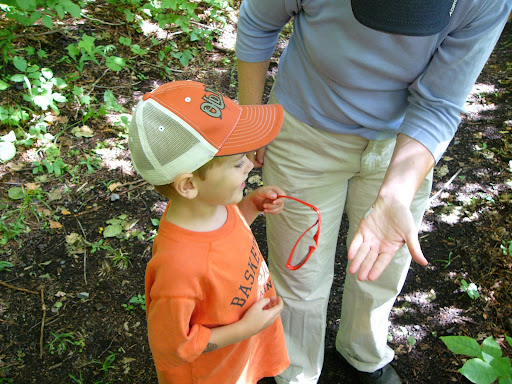
After Grace and I got back from the work hike on the morning of July 4, we took Dylan on another hike. Unfortunately I've not had the time to document it until now. But perhaps February is an appropriate time for a July retrospective: I know that looking back on the light and colors of summer makes me smile.


Dylan was very excited to get back to the Link Trail. It's times like this when I feel like I could stop counting my blessings at one, and still consider myself lucky.

I started to present him with his choices for places to hike, and at first I didn't get beyond "We could go back to the bridge over the creek where you threw sticks in, or we could go to the quarry..." He interjected that he wanted to go back to the quarry, but I said "Slow down, you haven't heard all the choices yet!" I continued, telling him that there are some parts of the Link Trail he hadn't seen, that go along a pretty stream. Immediately he changed his mind, saying he wanted to go to the part where he hadn't been!

We drove to Bingley and parked in the little area at the end of Emhoff Road. While looking at wildflowers right next to the parking area, I got excited at seeing a small toad. Unfortunately I lost it before I could show it to Dylan. We went north a few hundred feet so that we could write in the trail register, and then headed south. As we descended the small gravel switchback trail to Bingley Road I explained to Dylan the concept of a switchback, and how we were walking gradually downward and across the slope rather than trying to go straight down. Then, after climbing the staircase, I explained to him that the fence with the door is there to let people through but keep four-wheelers out.

Before we got far, I got excited about photo ops and Dylan got excited about construction equipment. His most excited exclamation of the day was "WOW, FRONT LOADER!!!" Having a quarry and a few private businesses with construction equipment along the trail is a huge bonus for hiking with a small boy.


Snail on plant

This snail was the first photo-op of the hike. This photo represents the state of my macro photography skills. The tail end of the snail, along with parts of the plant it's climbing, are in focus, but its antennae are little more than a blur. Yes, this gives a sense of intimacy and focus on the rear shell patterns, but I would like to be able to choose to have more of the critter in focus, and for that I need to spend more timer jiggering with F-stops and exposures and ISO settings.


Deptford pink

This species has been a favorite companion ever since around 1992, when I began my wildflower hikes. It's an elusively narcissistic little bugger: it doesn't deign to show its face at my parties very often, but on those occasions when I catch a blast of saturated pink from the side of the trail, I always stop and smile. How could I do otherwise?


Forget-me-not

Here's what I wrote after my first, erroneous attempt to identify this flower.

Wow. I just had one of those frustrating experiences where I thought I knew something and then I spent the better part of an hour having Google and Wikipedia teach me otherwise. This looks like what my mother used to call "baby's breath" but, as it turns out, that's about as definite as saying "That's a Queen Anne's lace". There are over 70 species of what people call Queen Anne's lace, and as it turns out there are about 100 species in the genus Gypsophilia. If anyone could tell me what species this is, I'd appreciate it.
As it turns out, I made the mistake I always make: confusing baby's breath with forget-me-not. This looks like a Myosotis laxa, or tufted forget-me-not. It also looks like Myosotis nemorosa, or possibly like several others on the Wikipedia page for the genus.


Harvestman

I can never resist a good shot of one of these fascinating creatures. For more on the ancient order Opiliones, see the Wikipidea entry.


What my father used to call a "water-skipper"

Sigh. I thought the term "baby's breath" was vague, but that's nothing compared to this insect's genus. Gerridae contains "around 500 known species, commonly placed in around 60 genera". Good luck figuring out which species this is. I know enough from the hours I've spent on BugGuide.net that I'd need
much more detailed pictures than this in order to get even close to identifying them.


We saw a fairly well-traveled trail coming in from the left that looked like private property to me, so I took the opportunity to tell Dylan about the importance of respecting private property and staying off it. Then we saw a big trail that led down the slope to the right. It was clearly a public fishing access, so we headed down to check it out. It turned out to be an ideal place to take a kid, and to take pictures. I tried to explain to Dylan how the steps beneath the culvert slow down the stream flow so that it hits the downstream pool as gently as possible and so minimimizes erosion. I don't know how well I did.


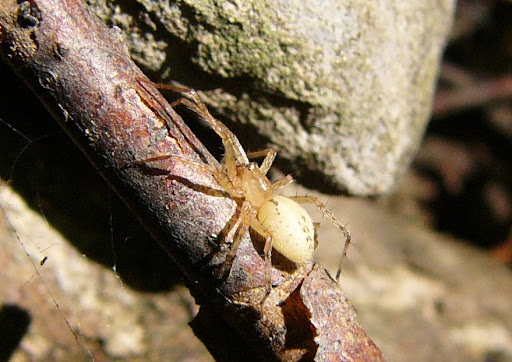
Unidentified arthropod on rock


Identified anthropoids on rocks


Buttercup

This is probably a common buttercup, or Ranunculus acris, but it could be one of a few Ranunculus. It's impossible to say for sure because I didn't get a shot of the stem or leaves.


We crossed the slippery, tippy rocks while holding Dylan's hand, and I got some great shots of flowers and arachnids and water-skippers. Grace got some shots of me and Dylan on the culvert, and we made our way back across the stream and up to the trail.


Fragrant bedstraw, or Galium triflorum

My first guess was wild madder because I remember that one from my old wildflower walks. But after looking it up in my Peterson's I think this is fragrant bedstraw. Note that the lower leaves are in whorls of six and that the stems appear to be hairless.


Tiny spider on leaf


Grace spinning Dylan

I'm grateful to Grace for being such a cheerful companion to Dylan, because it gives me some leeway for lagging behind and snapping away with the camera. She kept him busy while I got many shots for the Link Trail wildflower guide that I'm hoping to start compiling soon. And of course there were the lucky finds of bees and spiders and such on some of those flowers. When I caught up with them, Grace was swinging him around like a giggling whirligig - a whirligiggle?


Wild basil, or Satureja vulgaris

I spent an hour or two identifying this plant. For most of that time I was in the blue/violet section of my Peterson's Guide to Wildflowers. It's not the first time I've made this mistake. A lot of flowers I think of as primarily blue, Peterson obviously thought of as primarily red. Also, judging from some of the botanical plates I found online, this particular species seems to have a blue variety and a pink variety.

So I was on the verge of pulling my hair out, thinking this was in the genus Mentha but not being able to find anything closer than pennyroyal. But the two were structurally different in enough ways that it seemed impossible that they could be the same plant.

I actually started to wonder if it was a speedwell but the blossoms looked much more like a mint than a speedwell. Finally I noticed on page 352 the note "See also pink and lavender species on p. 252." Once I started looking in the red/pink flowers, it was only a matter of time before I discovered the wild basil. I gave myself a mental forehead-smack just now as I noticed the following words at the front page of the "Violet to Blue Flowers" chapter.
We repeat the warning here that it is not always easy to separate some lavender or reddish-purple flowers (treated in a pink-red section, which starts on page 212) from some violet ones, shown here in the following pages. If in doubt, look in both places.
I won't forget again.


Hop clover, or Trifolium agrarium

When I looked at the nodding head on the left I thought "hops". Imagine my delight when I found the following entry on page 150 of my Peterson's Guide to Wildflowers:
...When flower heads (1/2-3/4 in.) wither, florets fold down, become brownish, suggesting dried hops.


Black-eyed susan, or Rudbeckia hirta


Heal-all, or Prunella vulgaris

If you have a Peterson's Guide to Wildflowers take a look at pages 350-351 (which unfortunately aren't available in the Google Books preview). I think that the general appearance of the flower head, combined with the near-toothless leaves, allows us to unambiguously identify it as heal-all.


Rough-fruited cinquefoil entertaining a guest


I've always gotten a smile from this very common species, and that was before I took these macro shots. That last shot is the best photo I've ever taken. I jumped up and down and squealed when I saw it on the screen. See a larger version of the shot here.


Yarrow, or Achillea millefolium.


Wood strawberry, or Fragaria vesca


Leaf miner tracks


Purple-flowering raspberry

This is a Purple-flowering Raspberry, or Rubus odoratus. Note the insect on the flower in the second picture. Don't see it? That's OK, I didn't know it was there when I was taking the shot! See the closeup in the third picture. That's one of my favorite things about nature photography: the surprises waiting for me when I look at the shots on a computer screen.

After about two hours browsing Bug Guide I believe that I've unambiguously identified the critter: Tarnished Plant Bug (Lygus lineolaris). If my image submission gets moved by one of the experts, I'll know I was wrong.


Cow vetch

I believe that this is cow vetch, or Vicia cracca.


Midges(?) swarming against a rock(???)

On the way back I saw one of those things that makes you stop and wonder just what you're looking at. The sun picked out a seed pod or somesuch suspended in midair between a tree and a rock, so I went to check out the spider web. As I approached the boulder a cloud of insects scattered away from it, some colliding with me and some zipping past me. But much of the cloud remained, swarming around the shaded face of the rock. They appeared to be battering themselves against it, although the motion was too frenetic to be quite sure what I was seeing. All that I know is that I've never seen anything like it. Take a look at the shots and tell me if you know what I saw.


Closeup of cinders from the old railroad bed

I asked Al Larmann about the material found on old railroad beds, and he said that gravel or other small stones were used, and that this was called ballast. I replied...
Thanks Al. I think you've led me to the answer. The Wikipedia page http://en.wikipedia.org/wiki/Track_ballast says that...
A good ballast should be strong, hard-wearing, stable, drainable, easy to clean, workable, resistant to deformation, easily available, and reasonably cheap to purchase.[2] Early railway engineers did not understand the importance of quality track ballast; they would use cheap and easily-available materials such as ashes, chalk, clay,[3] earth, and even cinders from locomotive fireboxes.[4] It was soon clear that good-quality ballast made of rock was necessary if there was to be a good foundation and adequate drainage.[3]
So am I correct in thinking that this material that covers parts of the Link Trail is cinders? It does seem like something that came from a furnace, because it seems far too light and porous to be unprocessed stone.
Al's reply goes into some interesting history of the railroad.
Hugh--
I concur--The original Cazenovia and Canastota RR was built about 1870. Although their surveying skills were good--given the manner in which they were able to find a way around the Perryville area falls and cut into the hills as you approached Cazenovia, I am sure that the basic ballast used was cinder based.I do not recall where I saw the comment, but there was some industry locally that generated a large quantity of cinders. The engines were small in size and limited in power output. I do remember that the original bridge in Cazenovia spanning the creek was tested by placing the steam engine upon it--it passed, an empirical solution.


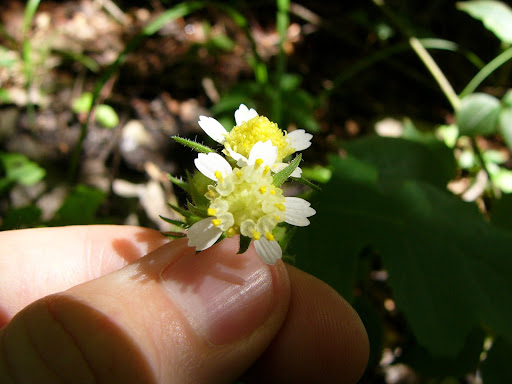
Daisy fleabane

I believe that this is daisy fleabane, or Erigeron annuus.


Tiny flies on oxeye daisy, or Leucanthemum vulgare


Yellow avens (Geum aleppicum) with aphid (nymph?) on blossom


The top picture shows the whole yellow avens plant. The second shows a cute little aphid on the blossom, and the third shows the distinctive fruit. Look closely - here's another example of spiderwebs being everywhere!


Bee pollinating oxeye daisy, or Leucanthemum vulgare


One last parting shot of Deptford pink

Sunday, October 26, 2008

A short hike on a bright autumn day


For more pictures, see the PicasaWeb album for this hike.

It was a pleasant, brightly sunny and cool day - perfect for a hike. Dylan was, as usual, very eager to go. We didn't have much time, so we opted for a quick walk along the section just west of the Cottons Road crossing. This allowed us to revisit the log that Dylan and I found during our hike in September. The tiny creatures burrowing into it had kept busy; sawdust was still raining out of the holes, of which I think none were more than a millimeter in diameter.

As usual, Grace and I were gratified to tell Dylan stories about the natural world. I showed him some hops and told him about how lots of people around here used to work picking them for the brewing of beer. The teasel gave me the opportunity to tell him the story of how people once used them to raise the nap on wool. And he showed me a particularly interesting rock.

It seemed that the season had conspired to create a palette that was bittersweet and intimate: curlicued teasel towered stolidly against the vibrant blue sky; the umber and russet of the maples and the rioting reds, yellows and greens of the sumac stood out against the fields, striped with austere yellow bands of crisped sweet corn and still-green bands of grass and clover; brilliant ruby apples hung from their green island in a spuming grey-brown sea of spent goldenrod.

Saturday, September 27, 2008

My first Link Trail goup hike

I've been wanting to join in a group hike since I discovered the Link Trail in May, but each time I was out of town or had other commitments. Today, though, I finally had the opportunity to meet some of the folks from the North Country Trail Association and the Adirondack Mountain Club who helped build - and who hike on - the Link Trail.

I met Jerry, Kathy, Kathy, Dawn, Janet and Amy at the Canastota Thruway exit at 9:00 AM. We drove to the trailhead next to Mount Pleasant Cemetery, left the cars there, and rode in Kathy's van to Cazenovia. We parked at the Cazenovia Highway Department and hit the trail just before 10:00 AM.

The sky was overcast but the rain held off for a while, so our first few miles of hiking along Chittenango Creek were full of pleasant chatting, greeting other hikers and runners, and wondering what the structure near the trail - collapsed except for an arch and the low remnants of its stone walls - might have been. Long before we reached Bingley the rain began falling in earnest and the jackets and ponchos came out. We admired the NCTA-built wooden staircase at Bingley Road, made our way along Emhoff Road, and reentered the woods.

The day seemed close, intimate: our world extended from the wooded slope on our right to the silver curtain of mist one or two hundred yards to our left. The grey sky hung low, and the dull pewter gleam of rain on every surface imparted a bittersweet beauty to the first bursts of fall colors amid the greenery of the overgrown orchards leading down into the valley. Here brilliant red berries nestled within slate-grey bracken, and there a small cluster of sumac leaves exploded with yellow and red. Fallen leaves - some speckled red and yellow, some a brilliant pink - had begun blanketing the trail. The mist-shrouded far side of the valley existed only in our imaginations.

As we passed the filled-in ravine I had the opportunity to show the group the collapsed remnants of the tallest mullein I've ever seen, and an example of the folding that spiders love to do with blackberry leaves in order to shelter their egg sacs. I enjoyed talking with my companions about travel, language, and history as we passed on toward Carrys Hill Road.

Walking over the old railroad bed toward Hodge Road, I noticed a white fuzzy caterpillar of a species that I don't think I've seen before. This may be the best way to describe what a good time I had today: I was so immersed in the hiking and the conversations with these engaging new people that, although I remembered to ask Kathy to take a picture of the caterpillar, I never thought to ask her to take one of us! Ah, well. Just picture a drizzle of rain falling from a grey sky through sparse tree cover and onto the heads of seven soggy people having lunch around a wooden vehicle barrier that separates the trail from the road. That's us.

We finished our lunch at around noon and walked the section of the Link Trail that follows roadsides down into Perryville and northward to the hedgerow at the end of Ingalls Corners Road. By this time the conversation had turned to politics, so I was glad when the trail - and we - plunged back into the trees. Somehow walking single-file through a hedgerow lends itself more to focusing on the hike than on our national three-ring circus.

We wound our way down the stone staircase that the NCTA volunteers worked so hard on this summer, rejoined the old railroad bed, and passed the quarry. By the time we crossed Quarry Road our pace had flagged but, knowing we had only a few miles to go, we soon perked up.

On the thirty mile hike in June my legs felt like they were on fire for a little while after I, wearing shorts, walked through a patch of stinging nettles near Cottons Road. After that hike I looked up the plant so that I could identify and avoid it, and today it paid off: I noticed a patch covering the trail and warned the group about it.

While Jerry and I were waiting in front of the car restoration shop on Cottons Road I noticed a link to Madison County history: a hop vine growing up the tree near the road. That vine was probably a direct descendant of those that formed a significant part of Madison County's economy during the nineteenth century, when itinerant workers picked the hop blossoms that were then dried and sent west to feed the beer industry. I picked some of those little cones to show the group, and spent the next mile or so pleasantly sniffing one of them while thinking of how I've come not only to love hoppy beers, but to have pleasant associations with the smell of raw hops!

We crossed Cottons Road and Nelson Road and then, during the last leg of the journey, Jerry and I decided to kick it up a notch. We maintained a very fast walking pace - well, very fast for me, but pretty normal for Jerry - for the last two miles. Jerry left and I, having gotten the power-walking out of my system, went back to keep the rest of the group company for the last stretch. I didn't get far, though - obviously they'd barely gone any slower than us, because I ran into them within three minutes. I think we were all grateful to reach the cars and rest our feet.

I'm excited to have met such a great group of people, and have already made plans with Jerry and Amy to do Adirondack snowshoeing and more Link Trail hiking. Yeah!

Saturday, August 9, 2008

When one hike just isn't enough


See my Picasaweb album for many more pictures from this hike.


By late morning my four-year-old nephew Dylan had asked me at least five times when we were going on a walk. I thought he might melt down completely if he had to wait until the afternoon, so to tide him over I took him on one of our traditional walks along Fairview Avenue. If you want to know much traffic has increased on Fairview in the last thirty years, walk along it with a four-year-old. I made sure to get us both well away from the road whenever cars were coming in each direction, which amounted to every few minutes. When I walked that same half mile of road as a child in the seventies I doubt I ever saw one tenth of the traffic I saw on Saturday. It makes me that much more thankful for quiet, secluded foot paths like the Link Trail.

We'd barely started when Dylan made me glad I'd brought my Peterson's Guide to Wildflowers. He pointed to what he thought was a dandelion. I couldn't remember what it was, so I took it as a teaching opportunity. I opened my Peterson's, found out that it was a sow-thistle, and pointed out some distinguishing characteristics: the tough, rough stem that resisted his attempts to pick a flower head; height; and leaf shape. We walked a half mile before we found a dandelion to compare it to, which itself was another opportunity to show Dylan how the seasons change and nature's forms flow: where earlier in the summer dandelions flourished we saw new flowers; the daylilies still stood there, but their brilliant orange blossoms were nearly all gone; we saw deadly nightshade for the first time this summer; one animal dead by the roadside had decomposed into nothing but bones, skin and hair; and the vulture circling overhead may have been attracted to the fresher carcass that we smelled as we walked by what used to be my uncle's farm. On the way back I pointed at the hedgerow across the road from the old farm and told him about the hop kiln that stood there when I was a child, and how people in this area once worked picking the hops that were used to make beer.


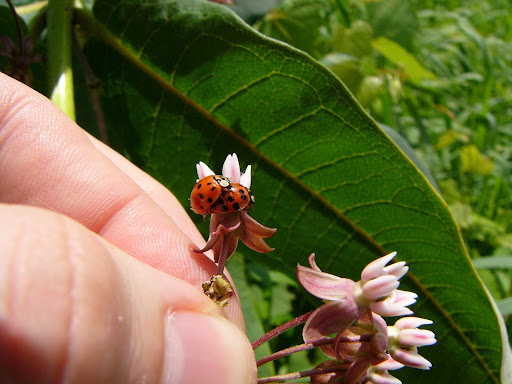
As we walked I pointed out the constant companions on our walks over the last few years: chicory, buttercup, tyrol knapweed, burdock, poison ivy, field bindweed, milkweed, butter-and-eggs, bird's-foot trefoil, and plaintain. Once again I made a point that he should recognize and avoid poison ivy, and that rubbing crushed plaintain on skin exposed to poison ivy can reduce the rash. We watched cloud shadows inch their way along the road and I tried to help Dylan visualize how the clouds move over the earth. When I pointed out two ladybugs mating on a milkweed plant I got the "What's mating?" question again, and again I said "That's when a male and a female get together to make babies." I'm going to have to figure out what to say when he asks for more of an explanation.

None of that took place on the Link Trail but I love my walks with Dylan so much that I couldn't resist telling about it. There's a worthier reason for including, though: it puts his receptiveness into perspective. When we went on the afternoon hike I'm about to describe, I'd already barraged him with all that information - and he was still eager for more!


In the afternoon Grace and I walked with Dylan from Quarry Road west to the quarry. I got preoccupied with a fascinating subject: a harvestman with three mites on its back. When I caught up with Grace and Dylan they were enjoying the view out over the valley. I kept falling behind whenever I'd find something interesting to photograph - first a spider that posed nicely for me on a root in the sunlight, then some wildflowers that were growing in a large patch but that I don't think I've seen before. Dylan enjoyed letting a caterpillar crawl on him. I noticed a tiny grey spider - its body was no more than two millimeters long - and the harvestman that was ambling toward it in that creepy way that reminds me of a Roger Corman movie. During the rest of the hike I noticed more and more of those tiny grey spiders. I'm starting to wonder if almost invisibly tiny spiders make up the majority of the spider biomass in the area, because now that I'm looking closely they seem to be everywhere.

Both the quarry and the snails that live nearby fascinate Dylan. He showed me the old machinery that he thought came from mowers, and I showed him the fragments of snail shell that I thought came from an animal eating the snail. As we started back I saw another harvestman with only five legs, so apparently it's not so uncommon a sight as I thought when I first noticed it a few weeks ago.


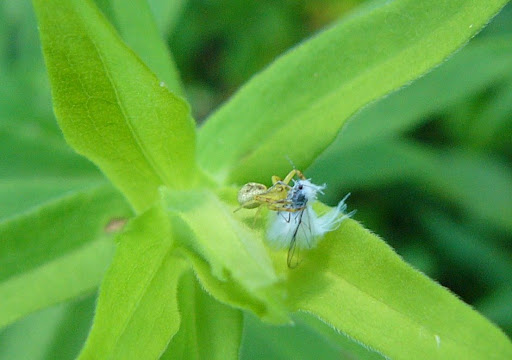
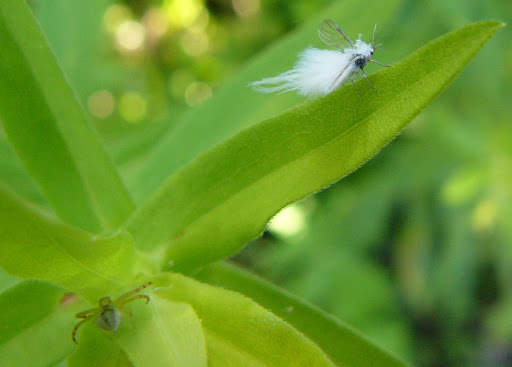
As we walked back past the quarry my eye locked onto a whitish piece of fuzz drifting on the air, and in a moment I knew it wasn't fuzz - it was an insect I'd seen only once before, on the Finger Lakes Trail in Ithaca around 1991. At the time I would have sworn it was a bit of fluff from a dandelion or a milkweed pod or somesuch, but after watching it "float" for a while I realized that it wasn't floating - it was flying in a way that mimicked floating. Obviously it made an impression, because here on the Link Trail seventeen years later it took me only a second to recognize another of the same species. Excited, I called Grace over to see. I didn't know I was about to get even more of a treat.

The insect seemed to be incredibly unlucky, because it happened to land on a plant about an inch from a small spider that immediately pounced. As I snapped away I figured I was getting shots of the insect's final moments, but I was wrong - after a few seconds of wrangling the spider disengaged and backed off, and the insect righted itself and flew away! I've since identified it as a woolly aphid. That "fuzz" is a waxy substance that, among other things, supposedly protects the aphid from predators. I'm not sure if that explains why the spider backed off, though, because I get the sense that the wax only hinders recognition; it's not clear to me whether it could have done anything to deter a predator that already had the aphid in its grasp.