Plan your Link Trail hike!


Sunday, September 7, 2008

Biological Buzzsaw


While hiking with Dylan along the section south of Cottons Road, I noticed some sort of powder beneath a dead tree trunk next to the trail. The trunk was bare, about eight inches in diameter, and suspended two or three feet off the ground. The closer I looked, the curiouser I got: it looked as though someone had sprinkled powder not only along the entire underside of the log, but all along its edge. I finally looked very closely, and saw that those clumps were small mounds of sawdust surrounding tiny holes less than one millimeter in diameter. So many tiny worms had been burrowing into the wood that they had created a trail of sawdust beneath the entire log!

A few days after the hike I had a conversation on the BugGuide forum about what the boring insects might have been. I'm writing this months later, and in the interim I've seen many trees like this one and at least one more example of the accumulation of sawdust from burrowing insects. This sort of biological breakdown of dead trees is, of course, going on all around me all the time; I just never noticed it before. It's one more example of my perceptions changing upon looking closely.

Tuesday, August 26, 2008

My latest obsession: BugGuide.net


A few weeks ago I began delving into BugGuide.net. Once I got used to navigating its pictorial taxonomic guide I was impressed with how easy it was to identify species I'd never seen before. Once I noticed its mapping tab - which shows geographic and seasonal distributions at any taxonomic level - and began uploading my own images, I was very impressed. It's quite a project, and I'm very thankful to all those who volunteer their time toward running the site and classifying submissions.

As far as the Link Trail is concerned, the neatest thing about BugGuide.net is its search engine. Each uploaded photo has an associated Identifier field where you can type whatever information you like, and this field is included in the search. The upshot is that, since I put the text "CNYLinkTrail" in the Identifier for each of my photos from the Link Trail, all I have to do is enter that text in the search box to show only those photos. And since the search specifications are part of the web address, I can provide a link directly to a page with all Link Trail pictures! This is the first step in compiling an entomological guide to the Link Trail - a guide to which anyone could add by simply uploading photos with the text "CNYLinkTrail" in the Identifier.

Saturday, August 9, 2008

When one hike just isn't enough


See my Picasaweb album for many more pictures from this hike.


By late morning my four-year-old nephew Dylan had asked me at least five times when we were going on a walk. I thought he might melt down completely if he had to wait until the afternoon, so to tide him over I took him on one of our traditional walks along Fairview Avenue. If you want to know much traffic has increased on Fairview in the last thirty years, walk along it with a four-year-old. I made sure to get us both well away from the road whenever cars were coming in each direction, which amounted to every few minutes. When I walked that same half mile of road as a child in the seventies I doubt I ever saw one tenth of the traffic I saw on Saturday. It makes me that much more thankful for quiet, secluded foot paths like the Link Trail.

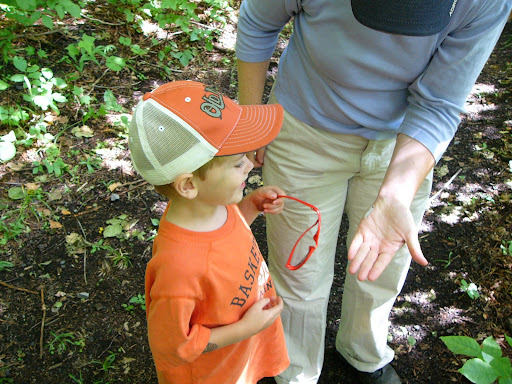
We'd barely started when Dylan made me glad I'd brought my Peterson's Guide to Wildflowers. He pointed to what he thought was a dandelion. I couldn't remember what it was, so I took it as a teaching opportunity. I opened my Peterson's, found out that it was a sow-thistle, and pointed out some distinguishing characteristics: the tough, rough stem that resisted his attempts to pick a flower head; height; and leaf shape. We walked a half mile before we found a dandelion to compare it to, which itself was another opportunity to show Dylan how the seasons change and nature's forms flow: where earlier in the summer dandelions flourished we saw new flowers; the daylilies still stood there, but their brilliant orange blossoms were nearly all gone; we saw deadly nightshade for the first time this summer; one animal dead by the roadside had decomposed into nothing but bones, skin and hair; and the vulture circling overhead may have been attracted to the fresher carcass that we smelled as we walked by what used to be my uncle's farm. On the way back I pointed at the hedgerow across the road from the old farm and told him about the hop kiln that stood there when I was a child, and how people in this area once worked picking the hops that were used to make beer.


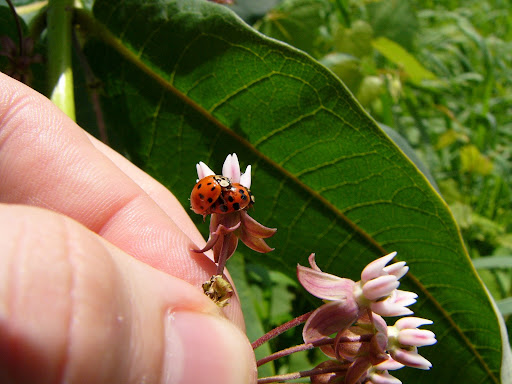
As we walked I pointed out the constant companions on our walks over the last few years: chicory, buttercup, tyrol knapweed, burdock, poison ivy, field bindweed, milkweed, butter-and-eggs, bird's-foot trefoil, and plaintain. Once again I made a point that he should recognize and avoid poison ivy, and that rubbing crushed plaintain on skin exposed to poison ivy can reduce the rash. We watched cloud shadows inch their way along the road and I tried to help Dylan visualize how the clouds move over the earth. When I pointed out two ladybugs mating on a milkweed plant I got the "What's mating?" question again, and again I said "That's when a male and a female get together to make babies." I'm going to have to figure out what to say when he asks for more of an explanation.

None of that took place on the Link Trail but I love my walks with Dylan so much that I couldn't resist telling about it. There's a worthier reason for including, though: it puts his receptiveness into perspective. When we went on the afternoon hike I'm about to describe, I'd already barraged him with all that information - and he was still eager for more!


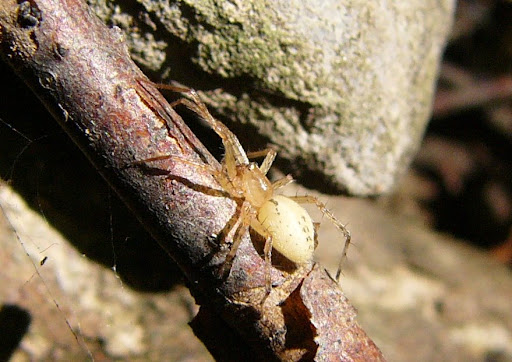
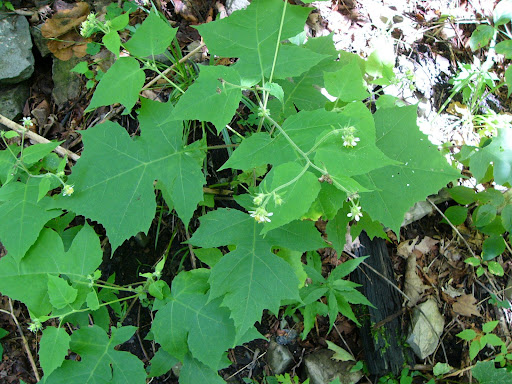
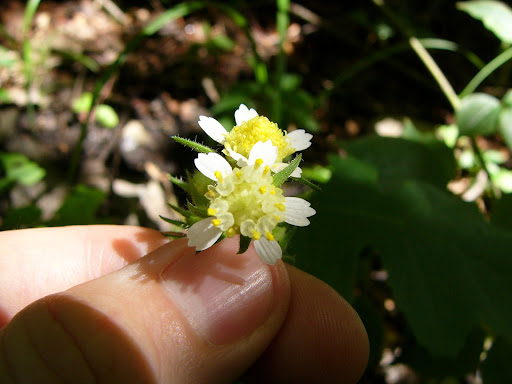
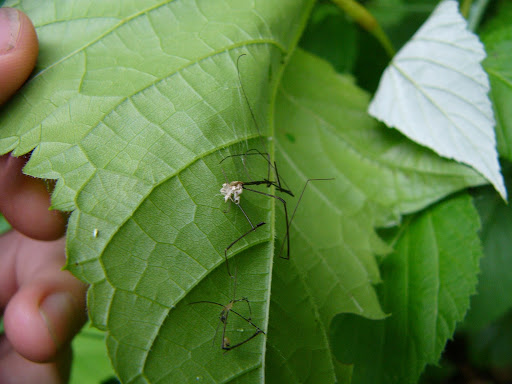
In the afternoon Grace and I walked with Dylan from Quarry Road west to the quarry. I got preoccupied with a fascinating subject: a harvestman with three mites on its back. When I caught up with Grace and Dylan they were enjoying the view out over the valley. I kept falling behind whenever I'd find something interesting to photograph - first a spider that posed nicely for me on a root in the sunlight, then some wildflowers that were growing in a large patch but that I don't think I've seen before. Dylan enjoyed letting a caterpillar crawl on him. I noticed a tiny grey spider - its body was no more than two millimeters long - and the harvestman that was ambling toward it in that creepy way that reminds me of a Roger Corman movie. During the rest of the hike I noticed more and more of those tiny grey spiders. I'm starting to wonder if almost invisibly tiny spiders make up the majority of the spider biomass in the area, because now that I'm looking closely they seem to be everywhere.

Both the quarry and the snails that live nearby fascinate Dylan. He showed me the old machinery that he thought came from mowers, and I showed him the fragments of snail shell that I thought came from an animal eating the snail. As we started back I saw another harvestman with only five legs, so apparently it's not so uncommon a sight as I thought when I first noticed it a few weeks ago.


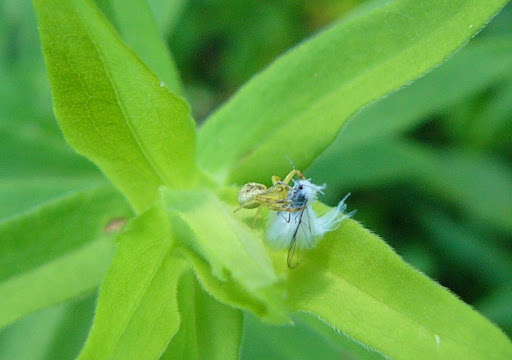
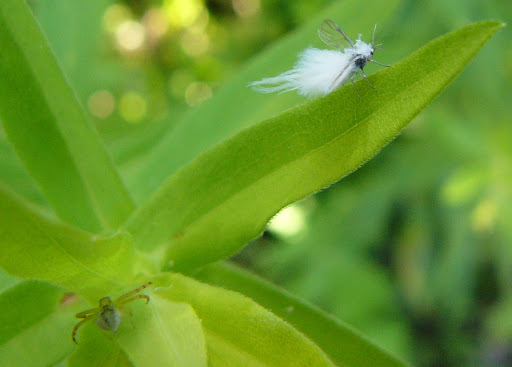
As we walked back past the quarry my eye locked onto a whitish piece of fuzz drifting on the air, and in a moment I knew it wasn't fuzz - it was an insect I'd seen only once before, on the Finger Lakes Trail in Ithaca around 1991. At the time I would have sworn it was a bit of fluff from a dandelion or a milkweed pod or somesuch, but after watching it "float" for a while I realized that it wasn't floating - it was flying in a way that mimicked floating. Obviously it made an impression, because here on the Link Trail seventeen years later it took me only a second to recognize another of the same species. Excited, I called Grace over to see. I didn't know I was about to get even more of a treat.

The insect seemed to be incredibly unlucky, because it happened to land on a plant about an inch from a small spider that immediately pounced. As I snapped away I figured I was getting shots of the insect's final moments, but I was wrong - after a few seconds of wrangling the spider disengaged and backed off, and the insect righted itself and flew away! I've since identified it as a woolly aphid. That "fuzz" is a waxy substance that, among other things, supposedly protects the aphid from predators. I'm not sure if that explains why the spider backed off, though, because I get the sense that the wax only hinders recognition; it's not clear to me whether it could have done anything to deter a predator that already had the aphid in its grasp.

Thursday, August 7, 2008

Music to my Ears


I got another dose of audio ambrosia from my four-year-old nephew today. I was talking to my sister on the phone and she asked if I wanted to say "Hi" to Dylan. She put him on and he said
"I can't wait for our next hike".
How cool is that?!

Two days ago Grace's father sent me this article about how children are growing up disconnected from the natural world. After reading it I feel even more blessed with my nephew's enthusiasm for our hikes: he's one kid who will grow up connected to the natural world. I'm really looking forward to introducing him to more of the trail and its inhabitants on Saturday.

Sunday, July 20, 2008

Harvestmen Harvested


See the Picasaweb album for more pictures from this hike.
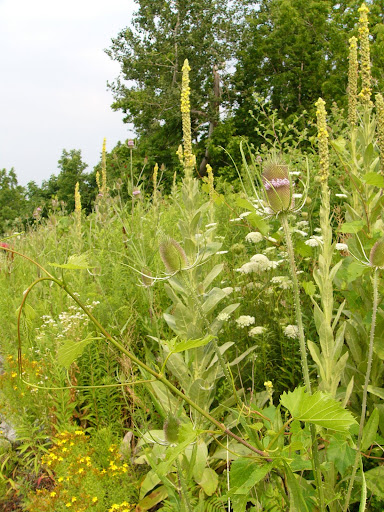


I love this time of year. Orange daylilies, blue chicory, and hot pink sweet peas shout from the roadside like some exuberant shapenote choir transposed from sound to color, and occasionally a patch of black-eyed susans bursts into a bravura solo. The only combination I like better happens in late summer when the fields fill with yellow and purple as the New England asters and the goldenrod blossom side by side.

I parked at the Freber (aka Hodge) Road trailhead and spent a few minutes enjoying the profusion of wildflowers. The mullein blossoms weren't what you'd call showy, but the way the spikes towered over the other plants made them seem like the natural leaders of the yellow contingent. Of course St John's wort, with its blasts of saturated yellow, kept drawing my eye back down near the ground. Looking upward again, I finally picked out the lemon-yellow stigmas of a few evening primrose that, as usual, I'd mistaken for mullein at first glance.

The teasels kept drawing my eye, and again I thought how particularly evocative they are. In the winter, when the rest of the dead flowers are laid low under a blanket of snow, the teasels stand there, alone and just as dead, with only a light dusting of snow to show for their stolidness. They have an aching sadness: all the life - all that was green and white and wet - has fallen away from their stems and pods, and what's left seems to embody the funereal dryness that Poe called "crisped and sere". On this summer day, though, they told a different story, catching my eye with their contrasting textures and colors. Each flash of delicate lavender was a band of tiny flowers around the middle of a pincushion-like head, which sat inside a phalanx of thorny bracts. After reading the Wikipedia article I know that that lavender band was poised to split; as a matter of fact, if you click on the picture above you'll see what Grace just noticed: on one of the teasels in the background the ring of blossoms had already split in two.
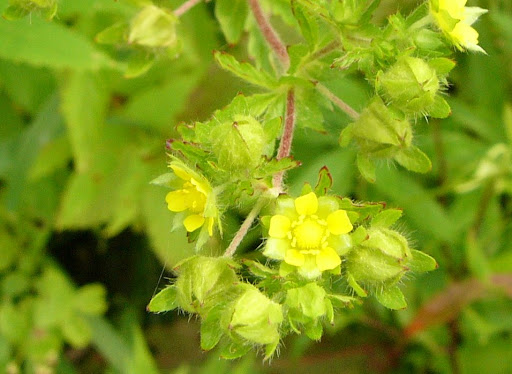


The Queen Anne's lace were in full flush, forming a sparse web over the lower greenery like a pearled snood. The good old Tyrol knapweed formed a vibrant purplish backdrop within the shadows of the lower greenery, while burnt umber froths of curled dock made the roadside look like it had been singed by a selective fire. Just before I headed onto the trail I noticed a yellow cinquefoil that I don't think I'd seen before. I've since identified it as rough cinquefoil.
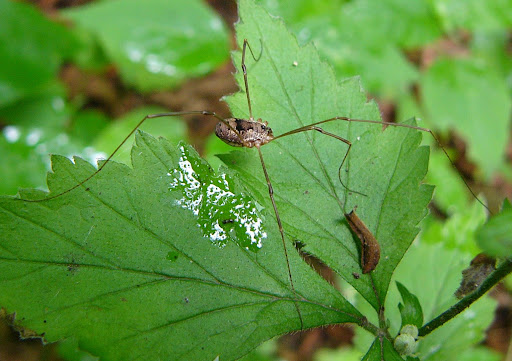


One of the first interesting things I saw was a harvestman with only five legs. I've seen plenty with one or two legs missing, but this is the first one I've noticed who'd lost three - and it had lost them all from one side! It seemed to be getting around perfectly well anyway.
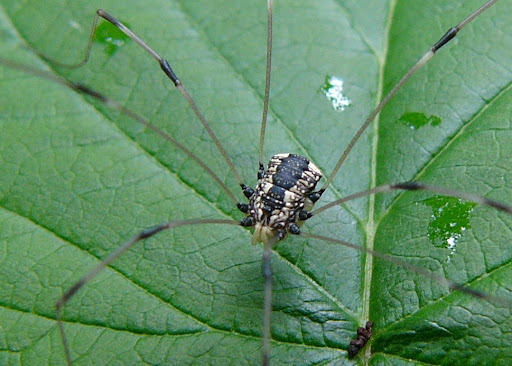


Moving on, I saw a harvestman of a species I didn't think I'd seen before - it's always hard to say because the details are too small to see with the naked eye. That's one of the reasons I love macro photography - the closeup shot of this guy revealed a beautiful Rorschach pattern dappling its body.


Within a few hundred yards I'd reached the blackberry patches that cover both sides of the trail. Two weeks earlier, back in Millburn, I'd noticed that the harvestmen seem to love wineberry bushes, so I inspected these blackberry bushes very closely. Not only did I find that each plant was practically covered with harvestmen, but I discovered the unexpected theme of the hike: I was walking through a hidden harvestman graveyard.

I'd seen plenty of spiders lurking within leaves that they'd curled up with their own webs, so when I noticed a downward-curled blackberry leaf on an otherwise thriving plant I turned it over to see what was underneath. The few small black filaments I saw looked surprisingly familiar: I was almost sure they were harvestman legs. At first I thought I might have been mistaken, and anyway the harvestmen might not have been eaten - they could have simply tugged free of those trapped legs and continued on. But I kept seeing similar bundles, so I started to think that some local spider favors harvestmen. Then I saw the flaw in my logic. This summer I've trained my eye to see harvestmen, and now it's clear that they are bloody well everywhere! And since they seem to be constantly crawling along every surface they may represent 99% of the species that ever touch those spider webs. Of course the spiders are eating harvestmen - they're the only game in town! And I did eventually find proof that the spiders were eating them: the biggest clump of remains contained not just legs, but the dried husk of a harvestman's body. See the straw-colored blob in the closeup above?
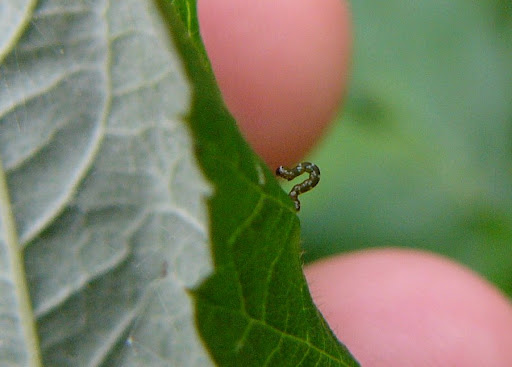
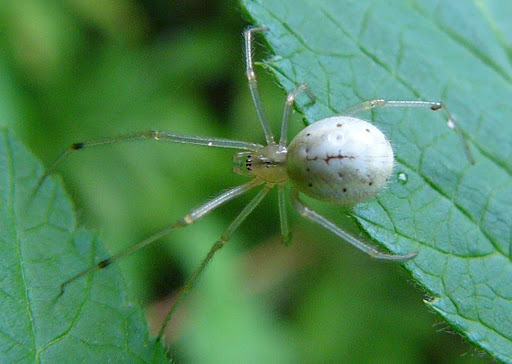
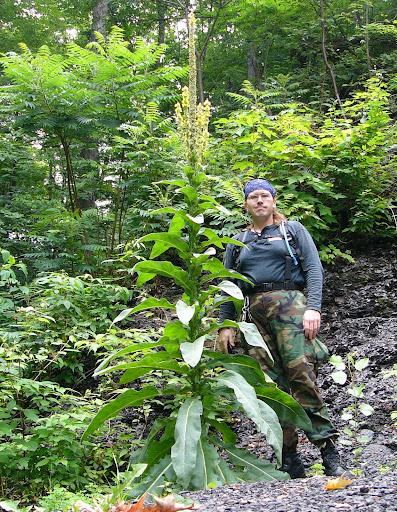
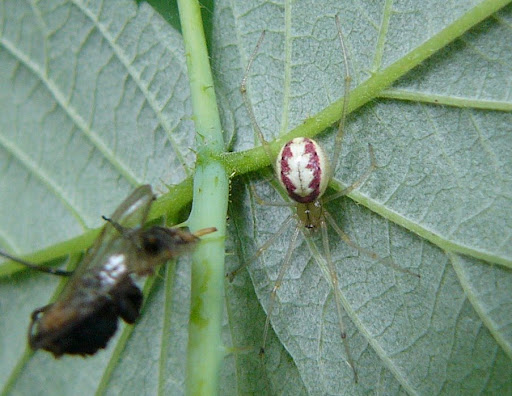


I saw more and more of those down-curled blackberry leaves - once my eye got the hang of it I couldn't stop seeing them - and although concealed webbing was responsible for all of them, I hardly found spiders under any of them. I began to think that I was seeing an arachnid behavior that was analagous to that of a human trapper: he sets a bunch of traps throughout his territory and then, as time allows, he comes along and checks them. Again I quickly saw a flaw in my logic: there could have been a spider beneath each one of those curled leaves five seconds before I came along, and the spider could have dropped off when it felt the vibrations from my footsteps. I think I was also wrong about a single species doing all the leaf-curling.

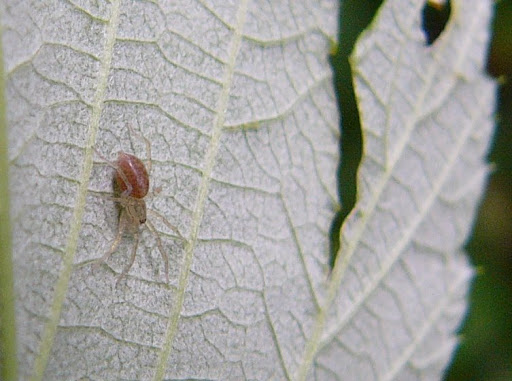
Of the few spiders I found under those curled leaves, almost all of them looked the same to me, and there was something pleasing to me about the thought of a single species of spider harvesting from this whole trail. Again, though, the macro shots tell a very different story. See the spider with the small black spots? I thought that was the same species as the one with the red racing stripes! If you look at the Picasaweb album you'll see other spiders - some with greenish colors, some with fawn-colored stripes - that I also thought were the same! It's amazing how our brains, given insufficient detail, will fill in the gaps in a way that's convenient for what we want to believe. I suspect that when I read up on spider behavior I'll find that this leaf-curling (and perhaps trapping?) behavior is as common as dirt.

While I was in minutiae mode I got to see a lot of the trail's tinier residents: as you can see from the size reference of my dirty fingernail, the inchworm would have fit inside the mouth of the wee frog from the previous day's hike; then there was the little pinkish spider that I almost didn't see because its body was just a few millimeters long. On the other hand, I ran across what I think is the tallest mullein I've ever seen; as you can see from the picture, it's about nine feet tall.

Saturday, July 19, 2008

A short hike with the young'uns


For more shots from this hike see the Picasaweb album.

Thrilled that my four-year-old nephew Dylan was anxious for more hiking with me, and that my sixteen-(going on thirty)-year old daughter Morgan was happy to join us, I hiked in with them from Ingalls Corners Road. They were both in shorts and sandals, so we were quite careful about identifying the plants growing over the trail throughout the hedgerow. To the best of my knowledge there was no poison ivy.


With a little help from me the sandalled youngsters enjoyed the climb down the stone stairs. Then the real fun began. A flash of motion drew my eye to the tiniest frog I've ever seen, but I lost it. While searching for it my eye caught a moving speck of white. It turned out to be an egg sac on the back of a spider that was smaller than a peppercorn. I lost her while utterly failing to find the frog. But then we saw a snail, and after that we couldn't stop seeing snails. They were vigorously foraging about in the rain-dampened leaf clutter. Dylan enjoyed allowing a few of them to explore his hand while I told him about the snail's foot and the way it uses its protective slime to move around safely.


My goal was to show Dylan the quarry because, like most four-year-olds, he's almost terminally fascinated with construction equipment and anything associated with them. I held Dylan on my shoulders so that he could get a better view of the quarry, while Morgan took some pictures with my camera. She favors black and white photography, and she thought the tree and the old concrete structure made a good composition. I have to admit that it wasn't until I saw the shot in black and white that I saw exactly what she meant.


On the way back I once again saw movement, and this time I didn't take my eyes off the wee frog. It was quite energetic in its sincere desire to be nowhere near us, and I fear we upset it quite a bit trying to corral it for a good shot. You be the judge of whether it was worth it.

On the way back along the hedgerow I got several more chances to explain things to my delightfully receptive nephew. I told him about the woodchucks that made the holes he was so curious about, and told Morgan about what good eatin' those woodchucks are. The raindrops highlighting the contours of funneled spider web gave me the perfect chance to tell my nephew how the spider hides in the tunnel until a bug lands in the web, and then jumps out, paralyzes it, and wraps it up in its web so that it can eat it later. And when we walked through the bloodroot patch I told how native Americans used the red sap of the roots for dyeing - and how I wasn't showing it to them because the plant is rare and protected.

I count myself blessed to have such opportunities to share the wonders of the natural world - a phrase that shouldn't sound like such a cliché - with two generations.

Tuesday, July 8, 2008

You want the short version or the long one?


Oh, this is just ridiculous. It's been two weeks since my latest hike and I've spent at least twice as long trying to write about it than I spent on the hike itself. So here goes.

Short version:
I walked from Nelson Road to Cottons Road and had a great time taking lots of closeup pictures of plants and insects and arachnids and such. I put my favorite shots in a Picasaweb album here.

Long version:
On my previous hike I covered thirty miles partly because I wasn't encumbered with a camera. On this hike I took over nine hundred digital photos but never got more than a mile from my car. Apparently I need to get the extremes out of the way before I can find a happy medium. I fall into the first extreme easily enough, losing myself in the ryhthm of pumping legs and heart as I strive for distance. It's harder for me to remember my need for hikes like this that are short on walking and long on looking - where I lose myself in tiny things. The camera helps.


I parked at the Nelson Road trailhead and walked west. The trail was full of bittersweet signs of seasonal change, reminding me that summer is old news and fall is around the corner. Late blossoms bloomed. Seed pods swelled where earlier blossoms had withered and fallen. Riots of vines twined around every standing plant, many giving up their strength to their reddening berries.


I'd intended to get five or ten miles of brisk hiking in, only stopping occasionally for some quick photos. Within ten minutes that plan had already gotten shaky. After failing to get a good shot of the dragonflies flitting about, I found a much more willing subject: a ladybug poised on a sumac leaf. Ten minutes later I got entranced by a weevil gathering nectar from a daisy fleabane blossom, and it was clear that the plan was in serious danger. Ten minutes after that the wheels came off the plan entirely. I'd already worked up a sweat trying to keep the camera steady while chasing and snapping away at the bees pollinating the white sweet clover. When my eye caught the snails climbing up those same plants - apparently to get to the choice leaves - I gave up on the idea of a long hike. I didn't mind too much. To explain why, I have to go back about fifteen years.

After college I spent lots of time walking along roadsides and through fields with my Peterson's Guide to Wildflowers. At first I just wanted to see some pretty flowers, increase my knowledge, and have a full journal to show for it. To identify a flower, though, I had to focus all my attention on it, and with that shift in focus came a shift in perception. One oxeye daisy stopped being one more white splotch among ten thousand other white splotches and became something singularly complex and beautiful. One moth mullein became a breathtaking dance of color, texture and form. One more periwinkle blossom became the first first periwinkle blossom I'd ever seen; after all, how could I say I'd seen it if I hadn't noticed that graceful spiral in the petals? In bringing my senses to bear totally on something outside myself I was bringing me outside myself: for a moment not everything was about me. I was seeing, and it was changing me.

Sometimes when I go on a walk I get lost in the act of finding and photographing subjects. After this last one I realized that it brings me the same sense of peace that wildflower identification brought me fifteen years ago. To take decent pictures I first have to slow down and look around for a good subject, so right off the bat I'm seeing my surroundings in a way I usually don't. Then in order to make the shot anything more than decent I have to figure out from what angle I want to view the subject, how I want to frame it, how the light falls on it and whether the lens barrel is shading it. Finally I have to hold my breath and pay extremely close attention to a detail on the subject as I turn the focus ring so that I can get the focus I want right down to the millimeter. Just like the act of identifying something, taking a good picture of something forces you to give it your complete attention. And I've come to understand that complete attention is not separable from love.


I moved on past the surprisingly acrobatic snails and came to another sign of the changing season. Two weeks earlier the small cluster of mullein had not begun to blossom, and the moth mullein right next to it were in late bloom. Now the yellow mullein blossoms were popping out of the stems and attracting ants, and the moth mullein blossoms had withered and all but fallen off while their seed pods had swelled and begun to split.


By this point I was beginning to think that good photo subjects were everywhere - if I looked closely enough at most any interesting plant I'd probably find some sort of interesting creature on it. I don't know whether I was right or I just got very lucky, but within moments I looked at some photogenically ripening berries and saw a daddy longlegs on the leaves right next to them. I'm afraid I aggravated it quite a bit, trying to coax it into position with my hand. Once I got my shots I left it in peace.

I moved on between the shrubs and vines, getting some nice shots of a fetching little bee I've not identified yet. Then I got the big payoff. If I hadn't spent the entire hike soaking up the tiny details of the trail I never would have spotted the fantastically well camouflaged moth that I just identified as a Virginia creeper sphinx.

I'm glad I had the opportunity to remember the joys of taking a long time for a short hike. I won't always have the chance to look so closely, but the next time I go on a thirty mile hike I'll have a better sense of the wonders filling every inch of those thirty miles.