Plan your Link Trail hike!


Sunday, July 20, 2008

Harvestmen Harvested


See the Picasaweb album for more pictures from this hike.
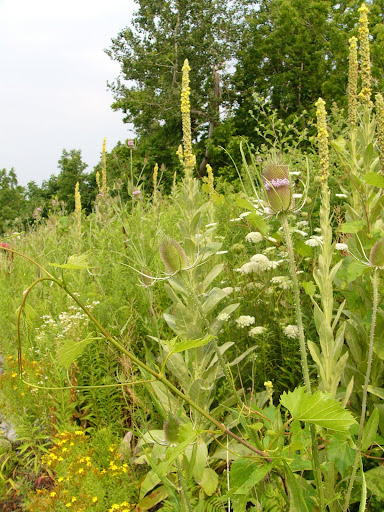


I love this time of year. Orange daylilies, blue chicory, and hot pink sweet peas shout from the roadside like some exuberant shapenote choir transposed from sound to color, and occasionally a patch of black-eyed susans bursts into a bravura solo. The only combination I like better happens in late summer when the fields fill with yellow and purple as the New England asters and the goldenrod blossom side by side.

I parked at the Freber (aka Hodge) Road trailhead and spent a few minutes enjoying the profusion of wildflowers. The mullein blossoms weren't what you'd call showy, but the way the spikes towered over the other plants made them seem like the natural leaders of the yellow contingent. Of course St John's wort, with its blasts of saturated yellow, kept drawing my eye back down near the ground. Looking upward again, I finally picked out the lemon-yellow stigmas of a few evening primrose that, as usual, I'd mistaken for mullein at first glance.

The teasels kept drawing my eye, and again I thought how particularly evocative they are. In the winter, when the rest of the dead flowers are laid low under a blanket of snow, the teasels stand there, alone and just as dead, with only a light dusting of snow to show for their stolidness. They have an aching sadness: all the life - all that was green and white and wet - has fallen away from their stems and pods, and what's left seems to embody the funereal dryness that Poe called "crisped and sere". On this summer day, though, they told a different story, catching my eye with their contrasting textures and colors. Each flash of delicate lavender was a band of tiny flowers around the middle of a pincushion-like head, which sat inside a phalanx of thorny bracts. After reading the Wikipedia article I know that that lavender band was poised to split; as a matter of fact, if you click on the picture above you'll see what Grace just noticed: on one of the teasels in the background the ring of blossoms had already split in two.
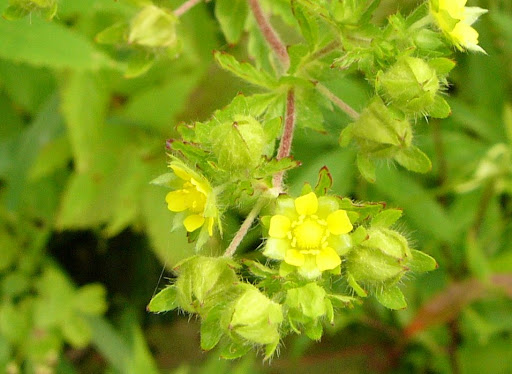


The Queen Anne's lace were in full flush, forming a sparse web over the lower greenery like a pearled snood. The good old Tyrol knapweed formed a vibrant purplish backdrop within the shadows of the lower greenery, while burnt umber froths of curled dock made the roadside look like it had been singed by a selective fire. Just before I headed onto the trail I noticed a yellow cinquefoil that I don't think I'd seen before. I've since identified it as rough cinquefoil.


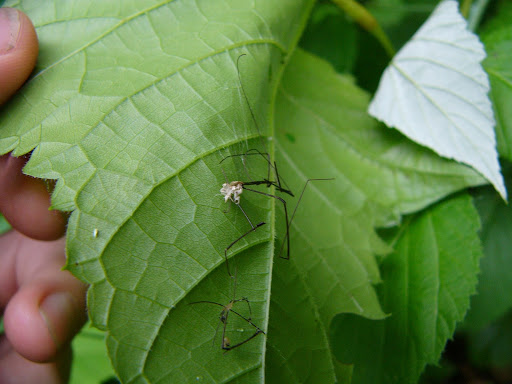
One of the first interesting things I saw was a harvestman with only five legs. I've seen plenty with one or two legs missing, but this is the first one I've noticed who'd lost three - and it had lost them all from one side! It seemed to be getting around perfectly well anyway.
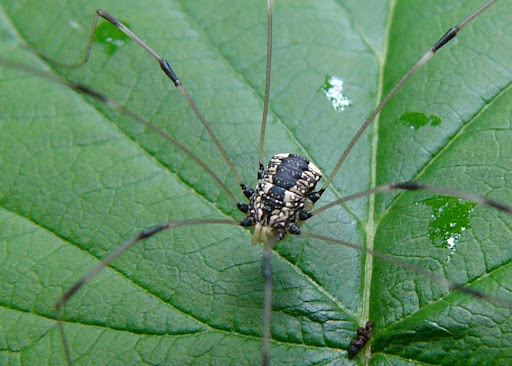


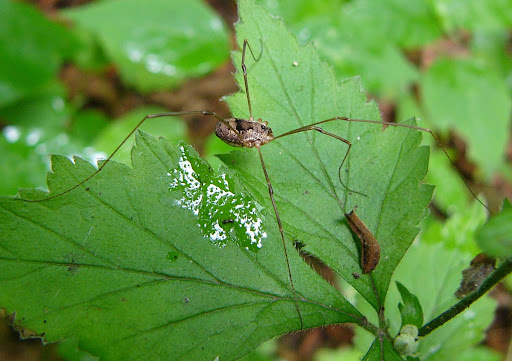
Moving on, I saw a harvestman of a species I didn't think I'd seen before - it's always hard to say because the details are too small to see with the naked eye. That's one of the reasons I love macro photography - the closeup shot of this guy revealed a beautiful Rorschach pattern dappling its body.


Within a few hundred yards I'd reached the blackberry patches that cover both sides of the trail. Two weeks earlier, back in Millburn, I'd noticed that the harvestmen seem to love wineberry bushes, so I inspected these blackberry bushes very closely. Not only did I find that each plant was practically covered with harvestmen, but I discovered the unexpected theme of the hike: I was walking through a hidden harvestman graveyard.

I'd seen plenty of spiders lurking within leaves that they'd curled up with their own webs, so when I noticed a downward-curled blackberry leaf on an otherwise thriving plant I turned it over to see what was underneath. The few small black filaments I saw looked surprisingly familiar: I was almost sure they were harvestman legs. At first I thought I might have been mistaken, and anyway the harvestmen might not have been eaten - they could have simply tugged free of those trapped legs and continued on. But I kept seeing similar bundles, so I started to think that some local spider favors harvestmen. Then I saw the flaw in my logic. This summer I've trained my eye to see harvestmen, and now it's clear that they are bloody well everywhere! And since they seem to be constantly crawling along every surface they may represent 99% of the species that ever touch those spider webs. Of course the spiders are eating harvestmen - they're the only game in town! And I did eventually find proof that the spiders were eating them: the biggest clump of remains contained not just legs, but the dried husk of a harvestman's body. See the straw-colored blob in the closeup above?
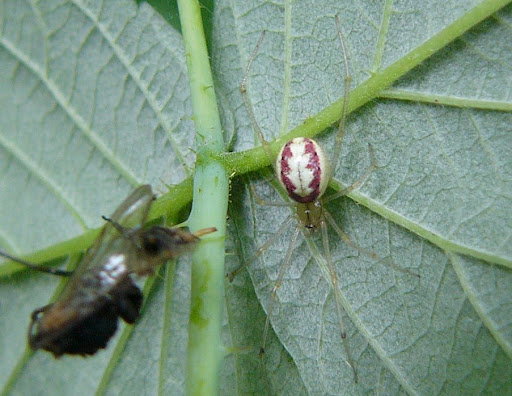


I saw more and more of those down-curled blackberry leaves - once my eye got the hang of it I couldn't stop seeing them - and although concealed webbing was responsible for all of them, I hardly found spiders under any of them. I began to think that I was seeing an arachnid behavior that was analagous to that of a human trapper: he sets a bunch of traps throughout his territory and then, as time allows, he comes along and checks them. Again I quickly saw a flaw in my logic: there could have been a spider beneath each one of those curled leaves five seconds before I came along, and the spider could have dropped off when it felt the vibrations from my footsteps. I think I was also wrong about a single species doing all the leaf-curling.

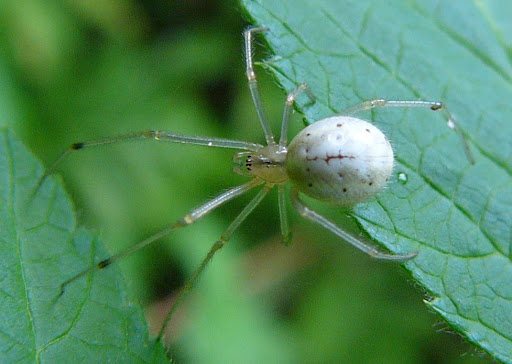
Of the few spiders I found under those curled leaves, almost all of them looked the same to me, and there was something pleasing to me about the thought of a single species of spider harvesting from this whole trail. Again, though, the macro shots tell a very different story. See the spider with the small black spots? I thought that was the same species as the one with the red racing stripes! If you look at the Picasaweb album you'll see other spiders - some with greenish colors, some with fawn-colored stripes - that I also thought were the same! It's amazing how our brains, given insufficient detail, will fill in the gaps in a way that's convenient for what we want to believe. I suspect that when I read up on spider behavior I'll find that this leaf-curling (and perhaps trapping?) behavior is as common as dirt.

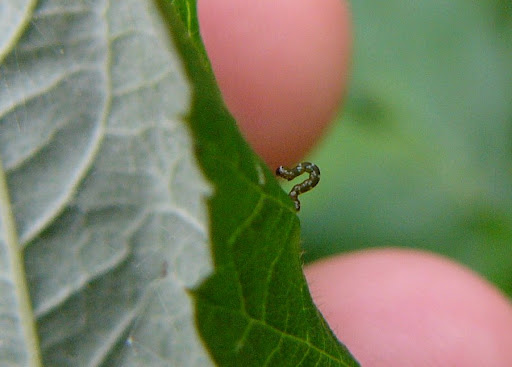
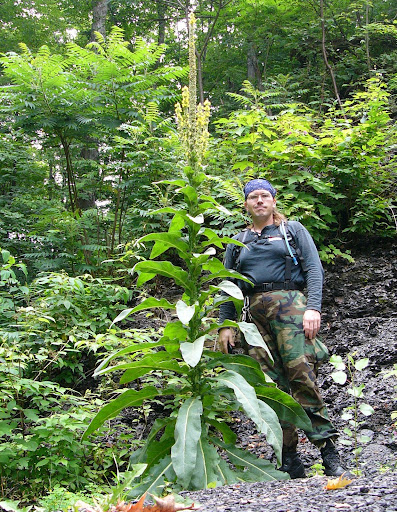
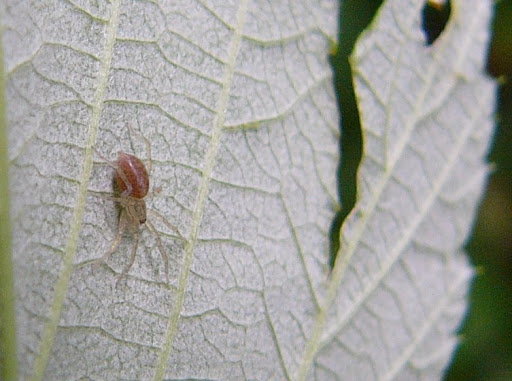
While I was in minutiae mode I got to see a lot of the trail's tinier residents: as you can see from the size reference of my dirty fingernail, the inchworm would have fit inside the mouth of the wee frog from the previous day's hike; then there was the little pinkish spider that I almost didn't see because its body was just a few millimeters long. On the other hand, I ran across what I think is the tallest mullein I've ever seen; as you can see from the picture, it's about nine feet tall.

Saturday, July 19, 2008

A short hike with the young'uns


For more shots from this hike see the Picasaweb album.

Thrilled that my four-year-old nephew Dylan was anxious for more hiking with me, and that my sixteen-(going on thirty)-year old daughter Morgan was happy to join us, I hiked in with them from Ingalls Corners Road. They were both in shorts and sandals, so we were quite careful about identifying the plants growing over the trail throughout the hedgerow. To the best of my knowledge there was no poison ivy.


With a little help from me the sandalled youngsters enjoyed the climb down the stone stairs. Then the real fun began. A flash of motion drew my eye to the tiniest frog I've ever seen, but I lost it. While searching for it my eye caught a moving speck of white. It turned out to be an egg sac on the back of a spider that was smaller than a peppercorn. I lost her while utterly failing to find the frog. But then we saw a snail, and after that we couldn't stop seeing snails. They were vigorously foraging about in the rain-dampened leaf clutter. Dylan enjoyed allowing a few of them to explore his hand while I told him about the snail's foot and the way it uses its protective slime to move around safely.


My goal was to show Dylan the quarry because, like most four-year-olds, he's almost terminally fascinated with construction equipment and anything associated with them. I held Dylan on my shoulders so that he could get a better view of the quarry, while Morgan took some pictures with my camera. She favors black and white photography, and she thought the tree and the old concrete structure made a good composition. I have to admit that it wasn't until I saw the shot in black and white that I saw exactly what she meant.


On the way back I once again saw movement, and this time I didn't take my eyes off the wee frog. It was quite energetic in its sincere desire to be nowhere near us, and I fear we upset it quite a bit trying to corral it for a good shot. You be the judge of whether it was worth it.

On the way back along the hedgerow I got several more chances to explain things to my delightfully receptive nephew. I told him about the woodchucks that made the holes he was so curious about, and told Morgan about what good eatin' those woodchucks are. The raindrops highlighting the contours of funneled spider web gave me the perfect chance to tell my nephew how the spider hides in the tunnel until a bug lands in the web, and then jumps out, paralyzes it, and wraps it up in its web so that it can eat it later. And when we walked through the bloodroot patch I told how native Americans used the red sap of the roots for dyeing - and how I wasn't showing it to them because the plant is rare and protected.

I count myself blessed to have such opportunities to share the wonders of the natural world - a phrase that shouldn't sound like such a cliché - with two generations.

Tuesday, July 8, 2008

You want the short version or the long one?


Oh, this is just ridiculous. It's been two weeks since my latest hike and I've spent at least twice as long trying to write about it than I spent on the hike itself. So here goes.

Short version:
I walked from Nelson Road to Cottons Road and had a great time taking lots of closeup pictures of plants and insects and arachnids and such. I put my favorite shots in a Picasaweb album here.

Long version:
On my previous hike I covered thirty miles partly because I wasn't encumbered with a camera. On this hike I took over nine hundred digital photos but never got more than a mile from my car. Apparently I need to get the extremes out of the way before I can find a happy medium. I fall into the first extreme easily enough, losing myself in the ryhthm of pumping legs and heart as I strive for distance. It's harder for me to remember my need for hikes like this that are short on walking and long on looking - where I lose myself in tiny things. The camera helps.


I parked at the Nelson Road trailhead and walked west. The trail was full of bittersweet signs of seasonal change, reminding me that summer is old news and fall is around the corner. Late blossoms bloomed. Seed pods swelled where earlier blossoms had withered and fallen. Riots of vines twined around every standing plant, many giving up their strength to their reddening berries.


I'd intended to get five or ten miles of brisk hiking in, only stopping occasionally for some quick photos. Within ten minutes that plan had already gotten shaky. After failing to get a good shot of the dragonflies flitting about, I found a much more willing subject: a ladybug poised on a sumac leaf. Ten minutes later I got entranced by a weevil gathering nectar from a daisy fleabane blossom, and it was clear that the plan was in serious danger. Ten minutes after that the wheels came off the plan entirely. I'd already worked up a sweat trying to keep the camera steady while chasing and snapping away at the bees pollinating the white sweet clover. When my eye caught the snails climbing up those same plants - apparently to get to the choice leaves - I gave up on the idea of a long hike. I didn't mind too much. To explain why, I have to go back about fifteen years.

After college I spent lots of time walking along roadsides and through fields with my Peterson's Guide to Wildflowers. At first I just wanted to see some pretty flowers, increase my knowledge, and have a full journal to show for it. To identify a flower, though, I had to focus all my attention on it, and with that shift in focus came a shift in perception. One oxeye daisy stopped being one more white splotch among ten thousand other white splotches and became something singularly complex and beautiful. One moth mullein became a breathtaking dance of color, texture and form. One more periwinkle blossom became the first first periwinkle blossom I'd ever seen; after all, how could I say I'd seen it if I hadn't noticed that graceful spiral in the petals? In bringing my senses to bear totally on something outside myself I was bringing me outside myself: for a moment not everything was about me. I was seeing, and it was changing me.

Sometimes when I go on a walk I get lost in the act of finding and photographing subjects. After this last one I realized that it brings me the same sense of peace that wildflower identification brought me fifteen years ago. To take decent pictures I first have to slow down and look around for a good subject, so right off the bat I'm seeing my surroundings in a way I usually don't. Then in order to make the shot anything more than decent I have to figure out from what angle I want to view the subject, how I want to frame it, how the light falls on it and whether the lens barrel is shading it. Finally I have to hold my breath and pay extremely close attention to a detail on the subject as I turn the focus ring so that I can get the focus I want right down to the millimeter. Just like the act of identifying something, taking a good picture of something forces you to give it your complete attention. And I've come to understand that complete attention is not separable from love.


I moved on past the surprisingly acrobatic snails and came to another sign of the changing season. Two weeks earlier the small cluster of mullein had not begun to blossom, and the moth mullein right next to it were in late bloom. Now the yellow mullein blossoms were popping out of the stems and attracting ants, and the moth mullein blossoms had withered and all but fallen off while their seed pods had swelled and begun to split.


By this point I was beginning to think that good photo subjects were everywhere - if I looked closely enough at most any interesting plant I'd probably find some sort of interesting creature on it. I don't know whether I was right or I just got very lucky, but within moments I looked at some photogenically ripening berries and saw a daddy longlegs on the leaves right next to them. I'm afraid I aggravated it quite a bit, trying to coax it into position with my hand. Once I got my shots I left it in peace.

I moved on between the shrubs and vines, getting some nice shots of a fetching little bee I've not identified yet. Then I got the big payoff. If I hadn't spent the entire hike soaking up the tiny details of the trail I never would have spotted the fantastically well camouflaged moth that I just identified as a Virginia creeper sphinx.

I'm glad I had the opportunity to remember the joys of taking a long time for a short hike. I won't always have the chance to look so closely, but the next time I go on a thirty mile hike I'll have a better sense of the wonders filling every inch of those thirty miles.

Friday, June 20, 2008

Well, it looked like a bird's foot to me.


Yesterday I called my sister and she told me about the conversation she'd had with my four year old nephew about "butter and eggs". That's what people around Oneida call the brilliant yellow wildflower that runs rampant in the hills where we grew up. He had told her "I think it's got another name," but what he said next seemed highly unlikely to her. She put him on the phone to repeat it and - in his adorable, hushed, four-year-old phone voice - said "birdfoot trefoil". I practically shouted "That's exactly right!" I was so proud to have taught him that during our hike on Saturday. It makes me happy that he's enjoying our hikes together enough to absorb information such as the story of how birdfoot trefoil got its name.

But here's the thing. It turns out that I didn't actually know how birdfoot trefoil got its name! I remember going on my wildflower walks in 1993, carrying my Peterson's Guide to Wildflowers along roadsides and through fields, and could have sworn that it said the name came from the angles of the leaf branching. When I Googled it just now, though, I found out that the name came from the appearance of the seed pods. Heck, I've never even looked at the seed pods - at least not that I remember. Now that I have, I can see the resemblance. But those leaf stalks still look like birds' feet to me! If you don't believe me, hold one up in your hand, look at the angle where the stalk divides into three, and think of the crook in a bird's leg.

...

No? Ah well. In any event, I'm teaching my nephew good stuff on our hikes.

Thursday, June 19, 2008

Ewwwwwwww!

I consider myself to be near the low end of the squeamishness spectrum. I grew up on a farm, and spent a few years in the nineties working in homes for developmentally disabled adults. Not only can I deal with the host of fluids that people and other creatures discharge, but in most cases I could do so with one hand while spooning Swiss Miss vanilla pudding into my mouth with the other. So when something makes me say "Ewwwwwwww!" it's noteworthy. Now you're probably thinking that this already sounds like a disgusting topic for a blog post, but I figure it's worth warning folks about the importance of adequately preparing one's feet for a very long hike. Hey, be thankful I'm not enough of a freak to include a photo.

My toenails had gotten longish by Saturday, and I suspected that was one of the main reasons for the pain in the big toe of my left foot after the hike. The farther the nail sticks out, the more of a moment arm it presents to any upward forces exerted on it, and that means more torque at the nail/cuticle boundary. I had made a mental note not only to cut my nails before I do any more hiking this weekend, but to always check their length - and, if necessary, trim them - before a hike.

So this morning I had a few minutes to spare, and I looked down and said "Hey, gotta trim those." I grabbed the clippers, grasped the toe in question, and started wondering again whether I might lose the nail. The pain had subsided since Saturday night, but it was still tender. There was a slight reddishness to the flesh beneath, like it was bruised. I began trimming. I nicked the cuticle and... there were fluids. No pain, just... fluids. Let's just leave it at that.

Again, this is not an self-indulgent exercise in being disgusting. Maybe this warning will keep you from losing a nail on a long hike. Or maybe you have much more experience than I, and can give me suggestions for preventing wear and tear on the toes. I didn't mind the full-body ache or the burning from the stinging nettles or the blisters, because I knew they'd fade in a few days. I'm going to lose at least part of this toenail, though, and that presents a more long-term inconvenience.

So, what can I do next time to treat my toes better? As I mentioned in the entry for that hike, I made the huge mistake of wearing only one pair of socks. Two or three pairs would have certainly mitigated the problem, but would they have solved it? I doubt it because I didn't have a problem with the big toe on my right foot. That means there's an asymmetry to my gait, because it stands to reason that my left foot is doing something that my right foot isn't. I need to correct that asymmetry if I'm to hike without damaging myself further. Luckily my fiancée, she gots th' mad physical therapy skillz, so she'll be able to set me straight - literally.

Sunday, June 15, 2008

There and Back Again - Canastota to Cazenovia and Back!

This image comes from my Google Map of the fifteen miles of trail between Canastota and Cazenovia. I hiked back and forth along that red line yesterday. But first, a word about why I was foolish enough not to get a good night's sleep before a thirty mile hike.

A dear friend of mine who joined the Air Force in December arrived back home in Oneida on Friday. This was his first leave, so I made a point to be there for the homecoming. I drove from New Jersey after work, so I didn't reach Oneida until around 11:30. I sat and talked with my friend and his family until a suspicious illumination spread on the horizon. I checked the time. It was nearly 5:00 AM - which is when I had intended to get up for my hike. I drove home, got two hours of sleep, got up, filled the water pouch of my new backpack, threw a few other things into it, grabbed a takeout breakfast at the Knotty Pine, and hit the trail at 8:40 AM.

The first interesting thing I saw that made me wish I'd brought my camera was a small carcass I found near the trail. There was nothing left but the head and the rear skin, as though the predator had intended to make a muskrat skin rug. The strange thing, though, was the webwork of glistening strands1 that covered the carcass and radiated outward onto the dirt for several inches. If my head was more easily turned by the horror movies I've seen recently I would have thought that a giant spider had spun a web over it before devouring it.

Focused on maintaining a brisk pace, I crossed Nelson Road at 9:19, Cottons Road at 9:35, and Quarry Road at 10:10. By then my legs were burning and red - presumably I'd walked through some stinging nettles and/or poison ivy. Note to self: wear long pants next time.

I reached Ingalls Corners Road at 10:33, the Freber/Hodge Road trailhead at 11:28, and Carrys Hill Road at 11:54. Before reaching Emhoff Road at 12:09 I had further cause to rue my decision not to burden myself with a camera: as I reached the fence just past the ravine with the staircase, I saw a doe and her small fawn a hundred yards to the west. The fawn was circling and nuzzling the mother, exploring its small world in a way that Samuel Pepys would surely have called "...the prettiest thing that ever I saw." I snapped away with my substandard phone camera, but even the best shots yielded little more than a blur. Oh, for that 12X zoom lens...


Between Bingley Road and Cazenovia I saw two peculiar insect mating rituals I'd never encountered before: the first pair, some species unkown to me2, were "face-to-face" but only touching by the tips of their abdomens. Then I noticed a pair of bumblebees, facing away from each other on a leaf, but also touching the tips of their abdomens.

I reached Route 20 in Cazenovia at 1:06. I had worked up quite an appetite, and was wondering where I should eat. Like an answer to my prayers, I saw signs advertising the chicken barbecue at the Methodist church. I made a beeline - well, the line a bee who has to ask directions makes, at any rate - and chowed down on a half chicken, a roll, salt potatoes, baked beans with just about the right amount of too much brown sugar, a brownie, and a cup of tea. Thoroughly refreshed, I hit the trail again at 2:03.

I had arranged with my sister to take my four year old nephew on part of my hike, so she dropped him off on Emhoff. He made it all the way to the Hodge Road trailhead under his own steam, although by then I'd gotten quite irritable, and I feel a little bad about that. See, I was already exhausted, and having to walk very slowly made it much worse. Under normal circumstances I'd enjoy his desire to stop, ask questions about everything he sees, and poke at things with sticks. Nearly falling asleep on my feet, though, I was not quite the patient teacher I wish to be. Still, I controlled myself well enough to tell him a bit about erosion and railroads, and begin inculcating him with the names of flowers such as oxeye daisy, birdfoot trefoil, musk mallow, and cow vetch. The slow pace added about an hour to my overall time.

On Hodge Road while pointing out musk mallow to my nephew I saw yet another pair of insects - another species we hadn't seen before - mating abdomen-to-abdomen on a leaf. Of course I had to go and tell him that they were mating, and of course he asked "What's 'mating'?". I hemmed and hawed and wondered what I might tell him that his mother might approve of, and settled on "They get together and make babies." That seemed to satisfy him. Whew.

By the time my sister met us on Hodge Road I had already done some serious thinking about cutting the hike short; my feet were aching, my back was stiff, and my head was reeling from exhaustion. But still, when she offered to give me a ride, I said "No, I want to finish this on my own steam." Thus began the struggle between my stubborn desire to follow through with my plan of making the whole hike from Canastota to Cazenovia and back, and my desire to rest the blistering stumps at the ends of my legs.


On Seibenbaum Road I experienced the most bitter missed photo opportunity of all. I saw a flash of color in the tall grass at the roadside, walked over, and saw one of the most fantastic compositions I've ever witnessed. Lurking beneath and behind a brilliant purple raceme of cow vetch was a striking white spider3. Hanging from the spider's jaws was an orange moth like so many I'd seen throughout the hike. The dramatic vignette, coupled with the purple-on-white-on-orange color scheme, made me nearly gnash my teeth in an impotent wish to have my camera in my hands.

By the time I reached Cottons Road the battle between that part of me that wanted to call my sister back for a pickup, and the part that would be damned if it gave up this close to the end, grew more and more furious. The two went back and forth, but the latter came out on top slightly more often. I had also realized that I'd forgotten one of my old cardinal rules: for long hikes, never wear less than two pairs of socks. For a thirty mile hike it should have been no less than three - the more planes of slippage between foot and shoe, the less friction between innermost sock and foot, yes? Or at least that's how I've always explained to myself the indisputably glad results of wearing multiple pairs. Unfortunately it had been so long since I'd taken such a long hike that I utterly forgot the rule this morning. Oh, will I be paying for that in the days to come. At one point I jumped up onto a log and felt such pain that I thought I'd torn a blister open. I took a look and discovered that I hadn't, so I doggedly continued.

By the time I plodded back over the well-known route between Nelson Road and the cemetery I was so stiff, and my feet were so sore, that I came to assume a gait that was positively arthritic. I reached my car at about 8:20. Nearly delirious with joy, I creaked my way slowly down into the driver's seat and got ready to exercise my newfound bragging rights.

The first thing I did when I got home - after inhaling a few slices of the pizza my sister thankfully had left over - was to wash all exposed skin with rubbing alcohol to remove any poison ivy oils. Until then I hadn't considered the possibility that one could get a high - and an unpleasant one at that - from rubbing alcohol fumes.

That night I rejoined my friend and his family, but it was difficult to relax amidst my personal constellation of discomfort. Of all the stiff joints, complaining muscles and throbbing pains the most worrisome was the big toe on my left foot - I began to wonder if I might lose the nail. Today it feels better, so I'm no longer worried. Also, the redness on my legs has not developed into a rash or blisters, so apparently the itching and burning was more from stinging nettles than poison ivy. I'm very satisfied with how the hike turned out, and eager to do it again. After my blisters heal and my muscles stop yelling at me. With long pants. And oh, so very many pairs of socks.

1This morning I told my sister about the glistening "web" covering the muskrat carcass and she brought up the possibility that it might have been made by slugs. I think she was right, because the strands did have the look of slime trails. I did a bit of Googling and found out that some snails feed on animal carcasses as well as plant material. Evidently there's a species in the Canastota area that loves carcasses.

2I didn't get a shot of them, but going from memory I think they may have been parasitic flat bark beetles.

3I identified it later as a female goldenrod spider.