Plan your Link Trail hike!


Friday, November 28, 2008

Three generations enjoying the snow


For more pictures, see the PicasaWeb album for this hike.

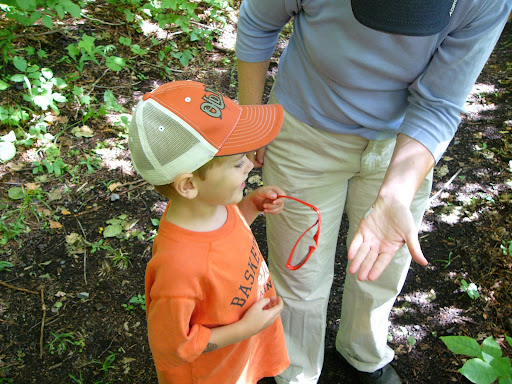
Dylan had been raring to get back to his beloved Link Trail, so Grace and I made sure to take him for a hike while we were in town for Thanksgiving. We were lucky enough to have Nathan available to join us. We parked at the Freber/Hodge Road trailhead and walked south onto the trail. Dylan, being four years old, is highly distractable, especially in the snow. Grace did an excellent job of keeping him on task; here is her description of her technique.

It was a mix of 3 things: context (what to expect from the outside world and feelings inside himself), locus of control (I gave him 2 choices, both acceptable, over and over.) and distraction (hero of his own sports story, sense of humor, silliness.)

A) I told him what to expect: how long it was before the end ("see that bend there, it's just beyond there" "we're more than halfway back to the car; can you look for the car?"), that it might feel difficult but that was normal and all the sports stars knew that the very end is harder work, that a little rest would give him alot more energy to run again (kids work in bursts - run, rest, run, rest).

B) I gave him 2 choices:
rest for 1 minute now or keep walking/rest later;
walk or run;
run now and shoulder ride later or walk and no shoulder ride

C) I did sports play by play narration of his running, which was apparently very inspiring and silly.

All this I learned from salon.com/tabletalk.

Thanks to Grace's efforts, Nathan and I had the opportunity to walk and talk amid the quietude of the stark winter day. The bare trees allowed us an open view down into the valley and the ravines. We all did our best to keep Dylan out of the wet spots. With Grace's coaching and coaxing, he did an impressive bit of running toward the end of the hike; he and Grace were one or two hundred yards ahead of me and Nathan by the time we reached the car!

Sunday, October 26, 2008

A short hike on a bright autumn day


For more pictures, see the PicasaWeb album for this hike.

It was a pleasant, brightly sunny and cool day - perfect for a hike. Dylan was, as usual, very eager to go. We didn't have much time, so we opted for a quick walk along the section just west of the Cottons Road crossing. This allowed us to revisit the log that Dylan and I found during our hike in September. The tiny creatures burrowing into it had kept busy; sawdust was still raining out of the holes, of which I think none were more than a millimeter in diameter.

As usual, Grace and I were gratified to tell Dylan stories about the natural world. I showed him some hops and told him about how lots of people around here used to work picking them for the brewing of beer. The teasel gave me the opportunity to tell him the story of how people once used them to raise the nap on wool. And he showed me a particularly interesting rock.

It seemed that the season had conspired to create a palette that was bittersweet and intimate: curlicued teasel towered stolidly against the vibrant blue sky; the umber and russet of the maples and the rioting reds, yellows and greens of the sumac stood out against the fields, striped with austere yellow bands of crisped sweet corn and still-green bands of grass and clover; brilliant ruby apples hung from their green island in a spuming grey-brown sea of spent goldenrod.

Saturday, October 18, 2008

A Blaze of Glory


I assumed that this work hike would involve trail-clearing so I loaded my trunk with axes and machetes. I left Oneida at 8:30, driving west through Clockville and south on Nelson Road. Other than the guy in the Saturn who passed me and the car ahead on a double line, it was a gorgeous, crisp, sunny morning. The valley was filling with more yellows and reds than I've seen around Oneida in years.

Just before 9:00 I pulled into the designated meeting spot: the parking area at the southwest tip of Cazenovia Lake. Then I found out that Kathy Eisele had sent me an e-mail telling me that all we'd be doing was marking trail. It turned out that Yahoo had put her message in my spam folder, so here I was with a trunk full of blades instead of the one thing I needed: a hammer. Thankfully Kathy had at least one extra.

Once everyone was gathered we formed a caravan and drove to the Dugway Road trailhead. Coordinator Kathy Eisele handed out the new blazes to the group: me, Margaret Maloney, George Zacharek, Kiley Barr, Ron and Linda Wallace, Patrick Dermody, Bill Zimmerman, Jonathan Bienes, Kurt Wheeler and his three young daughters, Chanda Vincent, and Al Larmann. The youngsters went ahead to clear some brush near the far end of the trail while the rest of us who weren't supervising them paired off. Each pair got a stack of yellow plastic rectangles with two holes for nails. Our job was to replace the old blue blazes with these new yellow ones.

Kathy instructed us to skip about a dozen markers ahead of the foremost pair and begin blazing from there. This leapfrog pattern would allow us to efficiently cover the whole trail. My partner Margaret and I started working on our section and I soon learned that there's more to trail marking than I'd expected. The basic rules turned out to be as follows.


  • Blaze on the right side of the trail.

  • Leave the nails sticking out so the tree has room to grow before it swallows the marker.

  • To indicate direction change use two blazes, the one on top offset in the direction of the turn.

  • Don't overblaze; if the old marker was unnecessary, don't replace it.

  • Don't blaze cherry trees; the wood is valuable.


It seemed to me that many of the previously marked trees were so young that a nail might kill them within a few years. I tried finding larger trees, but in many cases the bark was so spongy and thick that I would have had to bury the nail. Sometimes there were no suitable trees on the right side of the trail, so we had to use a cherry or a tree on the left. All the rules seemed made to be broken.

Margaret and I alternated friendly chatting with scratching our heads over which blazes not to replace (the trail was seriously overblazed) and which rules to break when there was no satisfactory tree to the right of the trail. Per our instructions we turned around when we ran into the group of youngsters and started working on the other side. I didn't count how many blazes we replaced but when I got back to the
trailhead at about 1:10 I was amazed at the enormous stack of blue markers filling my cargo pocket. We'd done more work than I'd realized.

Saturday, September 27, 2008

My first Link Trail goup hike

I've been wanting to join in a group hike since I discovered the Link Trail in May, but each time I was out of town or had other commitments. Today, though, I finally had the opportunity to meet some of the folks from the North Country Trail Association and the Adirondack Mountain Club who helped build - and who hike on - the Link Trail.

I met Jerry, Kathy, Kathy, Dawn, Janet and Amy at the Canastota Thruway exit at 9:00 AM. We drove to the trailhead next to Mount Pleasant Cemetery, left the cars there, and rode in Kathy's van to Cazenovia. We parked at the Cazenovia Highway Department and hit the trail just before 10:00 AM.

The sky was overcast but the rain held off for a while, so our first few miles of hiking along Chittenango Creek were full of pleasant chatting, greeting other hikers and runners, and wondering what the structure near the trail - collapsed except for an arch and the low remnants of its stone walls - might have been. Long before we reached Bingley the rain began falling in earnest and the jackets and ponchos came out. We admired the NCTA-built wooden staircase at Bingley Road, made our way along Emhoff Road, and reentered the woods.

The day seemed close, intimate: our world extended from the wooded slope on our right to the silver curtain of mist one or two hundred yards to our left. The grey sky hung low, and the dull pewter gleam of rain on every surface imparted a bittersweet beauty to the first bursts of fall colors amid the greenery of the overgrown orchards leading down into the valley. Here brilliant red berries nestled within slate-grey bracken, and there a small cluster of sumac leaves exploded with yellow and red. Fallen leaves - some speckled red and yellow, some a brilliant pink - had begun blanketing the trail. The mist-shrouded far side of the valley existed only in our imaginations.

As we passed the filled-in ravine I had the opportunity to show the group the collapsed remnants of the tallest mullein I've ever seen, and an example of the folding that spiders love to do with blackberry leaves in order to shelter their egg sacs. I enjoyed talking with my companions about travel, language, and history as we passed on toward Carrys Hill Road.

Walking over the old railroad bed toward Hodge Road, I noticed a white fuzzy caterpillar of a species that I don't think I've seen before. This may be the best way to describe what a good time I had today: I was so immersed in the hiking and the conversations with these engaging new people that, although I remembered to ask Kathy to take a picture of the caterpillar, I never thought to ask her to take one of us! Ah, well. Just picture a drizzle of rain falling from a grey sky through sparse tree cover and onto the heads of seven soggy people having lunch around a wooden vehicle barrier that separates the trail from the road. That's us.

We finished our lunch at around noon and walked the section of the Link Trail that follows roadsides down into Perryville and northward to the hedgerow at the end of Ingalls Corners Road. By this time the conversation had turned to politics, so I was glad when the trail - and we - plunged back into the trees. Somehow walking single-file through a hedgerow lends itself more to focusing on the hike than on our national three-ring circus.

We wound our way down the stone staircase that the NCTA volunteers worked so hard on this summer, rejoined the old railroad bed, and passed the quarry. By the time we crossed Quarry Road our pace had flagged but, knowing we had only a few miles to go, we soon perked up.

On the thirty mile hike in June my legs felt like they were on fire for a little while after I, wearing shorts, walked through a patch of stinging nettles near Cottons Road. After that hike I looked up the plant so that I could identify and avoid it, and today it paid off: I noticed a patch covering the trail and warned the group about it.

While Jerry and I were waiting in front of the car restoration shop on Cottons Road I noticed a link to Madison County history: a hop vine growing up the tree near the road. That vine was probably a direct descendant of those that formed a significant part of Madison County's economy during the nineteenth century, when itinerant workers picked the hop blossoms that were then dried and sent west to feed the beer industry. I picked some of those little cones to show the group, and spent the next mile or so pleasantly sniffing one of them while thinking of how I've come not only to love hoppy beers, but to have pleasant associations with the smell of raw hops!

We crossed Cottons Road and Nelson Road and then, during the last leg of the journey, Jerry and I decided to kick it up a notch. We maintained a very fast walking pace - well, very fast for me, but pretty normal for Jerry - for the last two miles. Jerry left and I, having gotten the power-walking out of my system, went back to keep the rest of the group company for the last stretch. I didn't get far, though - obviously they'd barely gone any slower than us, because I ran into them within three minutes. I think we were all grateful to reach the cars and rest our feet.

I'm excited to have met such a great group of people, and have already made plans with Jerry and Amy to do Adirondack snowshoeing and more Link Trail hiking. Yeah!

Sunday, September 7, 2008

Biological Buzzsaw


While hiking with Dylan along the section south of Cottons Road, I noticed some sort of powder beneath a dead tree trunk next to the trail. The trunk was bare, about eight inches in diameter, and suspended two or three feet off the ground. The closer I looked, the curiouser I got: it looked as though someone had sprinkled powder not only along the entire underside of the log, but all along its edge. I finally looked very closely, and saw that those clumps were small mounds of sawdust surrounding tiny holes less than one millimeter in diameter. So many tiny worms had been burrowing into the wood that they had created a trail of sawdust beneath the entire log!

A few days after the hike I had a conversation on the BugGuide forum about what the boring insects might have been. I'm writing this months later, and in the interim I've seen many trees like this one and at least one more example of the accumulation of sawdust from burrowing insects. This sort of biological breakdown of dead trees is, of course, going on all around me all the time; I just never noticed it before. It's one more example of my perceptions changing upon looking closely.

Tuesday, August 26, 2008

My latest obsession: BugGuide.net


A few weeks ago I began delving into BugGuide.net. Once I got used to navigating its pictorial taxonomic guide I was impressed with how easy it was to identify species I'd never seen before. Once I noticed its mapping tab - which shows geographic and seasonal distributions at any taxonomic level - and began uploading my own images, I was very impressed. It's quite a project, and I'm very thankful to all those who volunteer their time toward running the site and classifying submissions.

As far as the Link Trail is concerned, the neatest thing about BugGuide.net is its search engine. Each uploaded photo has an associated Identifier field where you can type whatever information you like, and this field is included in the search. The upshot is that, since I put the text "CNYLinkTrail" in the Identifier for each of my photos from the Link Trail, all I have to do is enter that text in the search box to show only those photos. And since the search specifications are part of the web address, I can provide a link directly to a page with all Link Trail pictures! This is the first step in compiling an entomological guide to the Link Trail - a guide to which anyone could add by simply uploading photos with the text "CNYLinkTrail" in the Identifier.

Saturday, August 9, 2008

When one hike just isn't enough


See my Picasaweb album for many more pictures from this hike.


By late morning my four-year-old nephew Dylan had asked me at least five times when we were going on a walk. I thought he might melt down completely if he had to wait until the afternoon, so to tide him over I took him on one of our traditional walks along Fairview Avenue. If you want to know much traffic has increased on Fairview in the last thirty years, walk along it with a four-year-old. I made sure to get us both well away from the road whenever cars were coming in each direction, which amounted to every few minutes. When I walked that same half mile of road as a child in the seventies I doubt I ever saw one tenth of the traffic I saw on Saturday. It makes me that much more thankful for quiet, secluded foot paths like the Link Trail.

We'd barely started when Dylan made me glad I'd brought my Peterson's Guide to Wildflowers. He pointed to what he thought was a dandelion. I couldn't remember what it was, so I took it as a teaching opportunity. I opened my Peterson's, found out that it was a sow-thistle, and pointed out some distinguishing characteristics: the tough, rough stem that resisted his attempts to pick a flower head; height; and leaf shape. We walked a half mile before we found a dandelion to compare it to, which itself was another opportunity to show Dylan how the seasons change and nature's forms flow: where earlier in the summer dandelions flourished we saw new flowers; the daylilies still stood there, but their brilliant orange blossoms were nearly all gone; we saw deadly nightshade for the first time this summer; one animal dead by the roadside had decomposed into nothing but bones, skin and hair; and the vulture circling overhead may have been attracted to the fresher carcass that we smelled as we walked by what used to be my uncle's farm. On the way back I pointed at the hedgerow across the road from the old farm and told him about the hop kiln that stood there when I was a child, and how people in this area once worked picking the hops that were used to make beer.


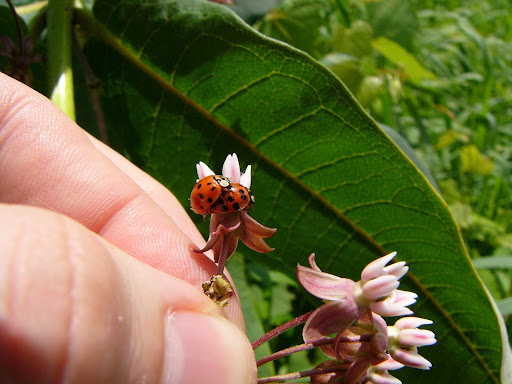
As we walked I pointed out the constant companions on our walks over the last few years: chicory, buttercup, tyrol knapweed, burdock, poison ivy, field bindweed, milkweed, butter-and-eggs, bird's-foot trefoil, and plaintain. Once again I made a point that he should recognize and avoid poison ivy, and that rubbing crushed plaintain on skin exposed to poison ivy can reduce the rash. We watched cloud shadows inch their way along the road and I tried to help Dylan visualize how the clouds move over the earth. When I pointed out two ladybugs mating on a milkweed plant I got the "What's mating?" question again, and again I said "That's when a male and a female get together to make babies." I'm going to have to figure out what to say when he asks for more of an explanation.

None of that took place on the Link Trail but I love my walks with Dylan so much that I couldn't resist telling about it. There's a worthier reason for including, though: it puts his receptiveness into perspective. When we went on the afternoon hike I'm about to describe, I'd already barraged him with all that information - and he was still eager for more!


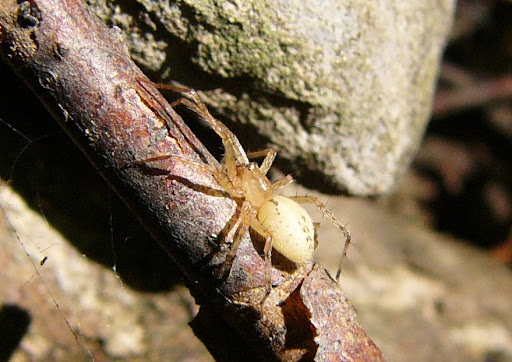
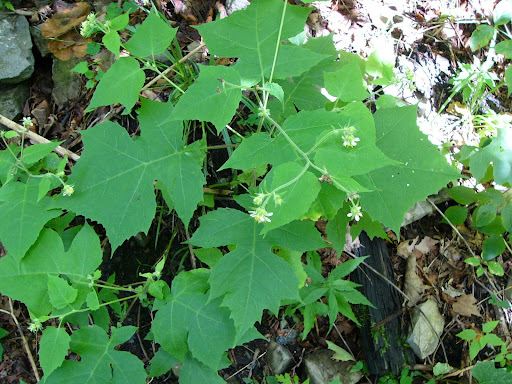
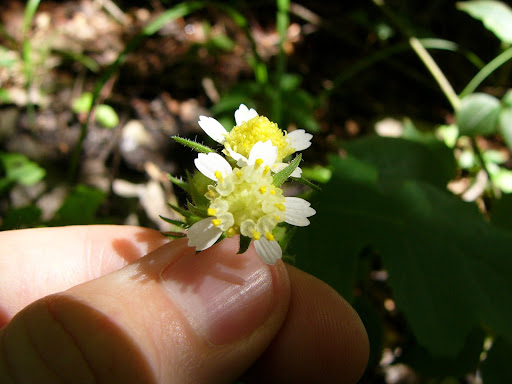
In the afternoon Grace and I walked with Dylan from Quarry Road west to the quarry. I got preoccupied with a fascinating subject: a harvestman with three mites on its back. When I caught up with Grace and Dylan they were enjoying the view out over the valley. I kept falling behind whenever I'd find something interesting to photograph - first a spider that posed nicely for me on a root in the sunlight, then some wildflowers that were growing in a large patch but that I don't think I've seen before. Dylan enjoyed letting a caterpillar crawl on him. I noticed a tiny grey spider - its body was no more than two millimeters long - and the harvestman that was ambling toward it in that creepy way that reminds me of a Roger Corman movie. During the rest of the hike I noticed more and more of those tiny grey spiders. I'm starting to wonder if almost invisibly tiny spiders make up the majority of the spider biomass in the area, because now that I'm looking closely they seem to be everywhere.

Both the quarry and the snails that live nearby fascinate Dylan. He showed me the old machinery that he thought came from mowers, and I showed him the fragments of snail shell that I thought came from an animal eating the snail. As we started back I saw another harvestman with only five legs, so apparently it's not so uncommon a sight as I thought when I first noticed it a few weeks ago.


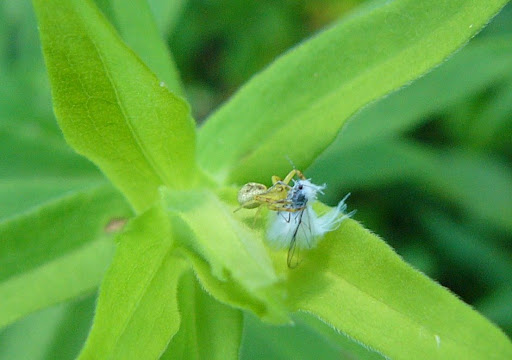
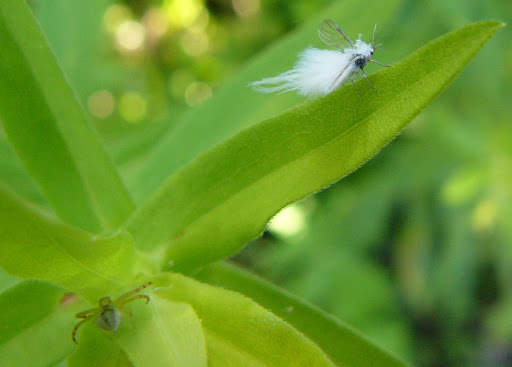
As we walked back past the quarry my eye locked onto a whitish piece of fuzz drifting on the air, and in a moment I knew it wasn't fuzz - it was an insect I'd seen only once before, on the Finger Lakes Trail in Ithaca around 1991. At the time I would have sworn it was a bit of fluff from a dandelion or a milkweed pod or somesuch, but after watching it "float" for a while I realized that it wasn't floating - it was flying in a way that mimicked floating. Obviously it made an impression, because here on the Link Trail seventeen years later it took me only a second to recognize another of the same species. Excited, I called Grace over to see. I didn't know I was about to get even more of a treat.

The insect seemed to be incredibly unlucky, because it happened to land on a plant about an inch from a small spider that immediately pounced. As I snapped away I figured I was getting shots of the insect's final moments, but I was wrong - after a few seconds of wrangling the spider disengaged and backed off, and the insect righted itself and flew away! I've since identified it as a woolly aphid. That "fuzz" is a waxy substance that, among other things, supposedly protects the aphid from predators. I'm not sure if that explains why the spider backed off, though, because I get the sense that the wax only hinders recognition; it's not clear to me whether it could have done anything to deter a predator that already had the aphid in its grasp.